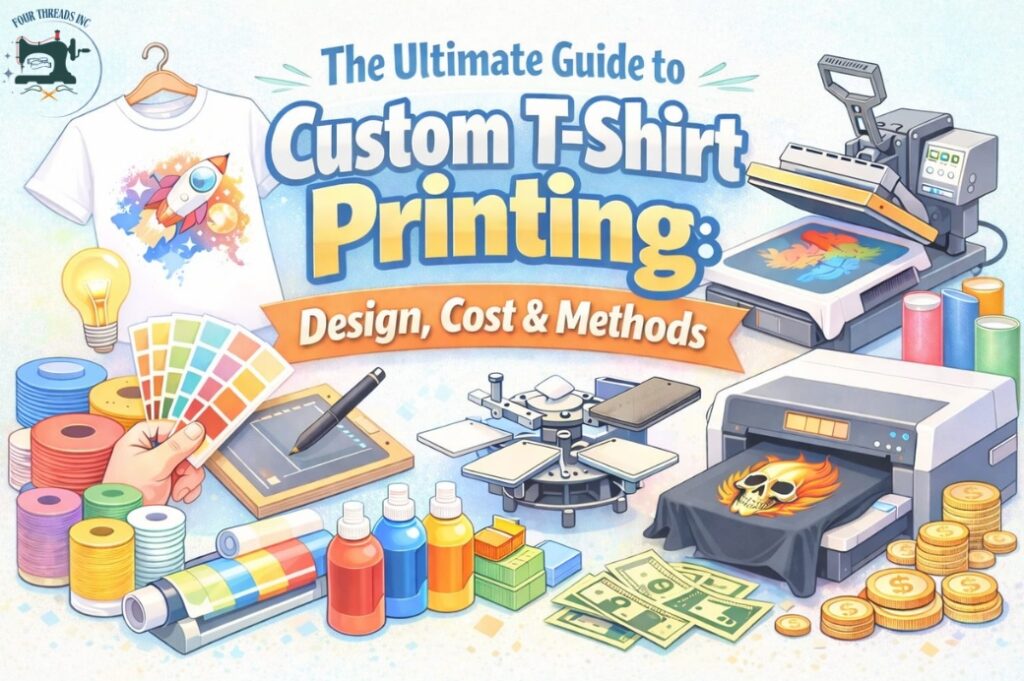
Custom T-shirt printing has exploded from a small segment to a major trend in a world where personal expression and brand identity are king. If you want to advertise a business, connect a sports team, or simply make a great gift, using the ability to print a design on fabric is very easy nowadays. In fact, since the international custom t-shirt printing market is expected to see very strong development, getting to know the specifics of this process will help you achieve the best results without excessive spending.
What Is Custom T-Shirt Printing and How Does It Work?
Simply put, custom t-shirt printing consists of putting a particular design, logo, or text on a blank piece of clothing. But the “how” part opens the door to various printing technologies, so each one is best targeted at different needs.
Many current companies operate online or through neighborhood print shops where you can submit a design, pick a t-shirt type, and decide on a printing technique. This is where digital art meets physical manufacturing to give a plain piece of cotton or polyester a makeover by turning it into a piece of wearable art.
What are the main steps involved?
- Design Creation:
It is highly recommended to connect these stages to a trustworthy supplier if you want the end product to depict the initial concept accurately. - Choosing a Method:
Having a good knowledge of these basics will not only help you save a lot of time but will also prevent the disappointment of finding your print peeling off after the very first laundry cycle. - Production & Curing:
Understanding the process ensures better durability and quality in your final output.
Breaking Down the Cost of Custom T-Shirt Printing
Pricing is the number one concern for almost everyone who wants to buy. In reality, the price is very seldom constant; besides varying greatly based on quantities, color inks, and shirt types, it can also depend on other factors.
A single piece using DTG or heat transfer will typically be priced at retail around ₹1,600–₹2,500. But when you buy, for example, for a corporate event, the cost per unit will be much lower due to economies of scale.
How does quantity affect the price?
If you are buying in bulk (e.g., 100 units), it will change your pricing model entirely.
With screen printing, the primary cost will be the setup (burning the screen), as it may represent 70–80% of the total order price. However, once the screen is made, printing additional shirts is very cheap.
- A standard back print (14×16 inches) may cost around ₹200 per shirt
- A small pocket print may add only ₹40 per shirt
As a matter of fact, Four Threads Inc is very good at providing not only printing but also very affordable bulk prices for businesses and teams without compromising on durability, allowing your promotional budget to go even further.
Choosing the Right Fabric: Understanding GSM
The look and feel of a custom t-shirt, as well as how long it lasts, depend heavily on an important specification: fabric weight, measured in GSM (Grams per Square Meter).
Many customers fail to check this specification, and as a result, they end up with a t-shirt that is either too heavy or too flimsy for their needs.
- Lower GSM (below 150): ideal for sportswear and hot climates
- Higher GSM (above 200): thicker, more premium garments
Is 240 GSM good quality for custom printing?
Definitely. 240 GSM is considered the “sweet spot” for premium everyday clothing.
It offers:
- A durable feel
- Better shape retention
- Wrinkle resistance
For sports t-shirt printing, lighter moisture-wicking polyester (140–160 GSM) is ideal. But for corporate or casual wear, 240 GSM cotton or blends provide a “heavy cotton” feel and a strong surface for prints.
Custom T-Shirt Printing Methods: Screen Printing vs. DTG
When choosing a service, you will mainly come across two technologies:
- Screen Printing
- Direct-to-Garment (DTG)
Making the wrong choice can lead to higher costs or poor quality.
Screen Printing (Best for Bulk & Logo Printing)
This traditional method involves pushing ink through a mesh stencil onto the shirt.
It is ideal for t-shirt logo printing because:
- Colors are vibrant and long-lasting
- Prints withstand repeated washing
However, setup costs are high. If you need 50+ shirts with a simple design, this is the most cost-effective option.
Direct-to-Garment (DTG) (Best for Photo & Small Batches)
DTG works like an inkjet printer for fabric, applying ink directly onto the material.
It is best for:
- T-shirt photo printing
- Complex, multi-color designs
- T-shirt name printing
Advantages:
- No setup cost
- Ideal for small orders
Drawbacks:
- Slightly less durable on heavy cotton
- Slower for bulk orders
Local vs. Online Printing Services
Depending on urgency, you might search for custom t-shirt printing near me or opt for online services.
Local Shops:
- Physical inspection of the product
- No shipping delays
- Best for urgent needs
Online Services:
- Better design interfaces
- Lower prices
- More variety
Why choose a specialized provider like Four Threads?
Whether you want local speed or online convenience, print quality is critical.
Four Threads stands out by offering:
- Accurate t-shirt printing design, color matching
- Eco-friendly inks for sports t-shirt printing
- Dedicated account managers for bulk orders
Unlike generic services, they ensure your artwork is verified before production.
Quick Glance: Your Custom Printing Checklist
Before placing your order, go through this checklist:
- Design Resolution: Is your image at least 300 DPI?
- Print Placement: Left chest, full back, or sleeve?
- Fabric Match: Cotton for DTG or polyester blends for sports?
- Order Quantity: Are you overpaying for DTG instead of bulk screen printing?
- Turnaround Time: Does “fast delivery” mean 2 days or 2 weeks?
Conclusion
Navigating custom t-shirt printing involves balancing art, science, and budget.
Understanding:
- 240 GSM = premium quality
- Screen printing = best for bulk
- DTG = best for detailed designs
These decisions directly impact your final product.
Whether you are ordering one shirt or 500, the goal remains the same: a durable, vibrant product you are proud to wear.
If you are looking for a reliable partner, Four Threads provides the expertise and service needed to bring your vision to life—ensuring your message is not just seen, but worn.
FAQs
Yes, you can use ChatGPT as an idea generator only. It is possible for ChatGPT to come up with text prompts or descriptions of design concepts, but it cannot produce a high-resolution final printable file that is ready for production.
To turn the AI-generated concept into a vector or raster image suitable for screen printing or DTG, you will either need the help of a graphic designer or use software like Photoshop.
Printing is the application of inks on the fabric layer, which results in graphics without any texture.
Embroidery involves stitching logos into the shirts with threads, giving a 3D effect and a textured feel to the designs.Besides the difference in cost, embroidery is the more durable option, which is why it is frequently used for corporate polos. On the other hand, custom t-shirt printing is the way to go for big, colorful designs on t-shirts.
Different methods mean different answers.
DTG printing and heat transfer usually have no minimum order (printing even one shirt is possible). Due to the setup costs of burning screens, the screen printing method typically implies a high MOQ (for example, 12 to 24 pieces).
Prices vary greatly depending on the region.
For example:
- In India: A bulk order of 100 t-shirts may cost as low as ₹300–₹500 per shirt
- In the US or UK: The same order may range from $10 to $15 per shirt
Local labor and material costs are the major reasons for this difference.
Usually, “fast delivery” or “rush printing” means the production time is shortened to 24 to 72 hours, plus shipping time.
Standard delivery typically takes 5 to 10 business days.
It is better to check whether the company charges an extra fee for rush orders.
Leave a Reply