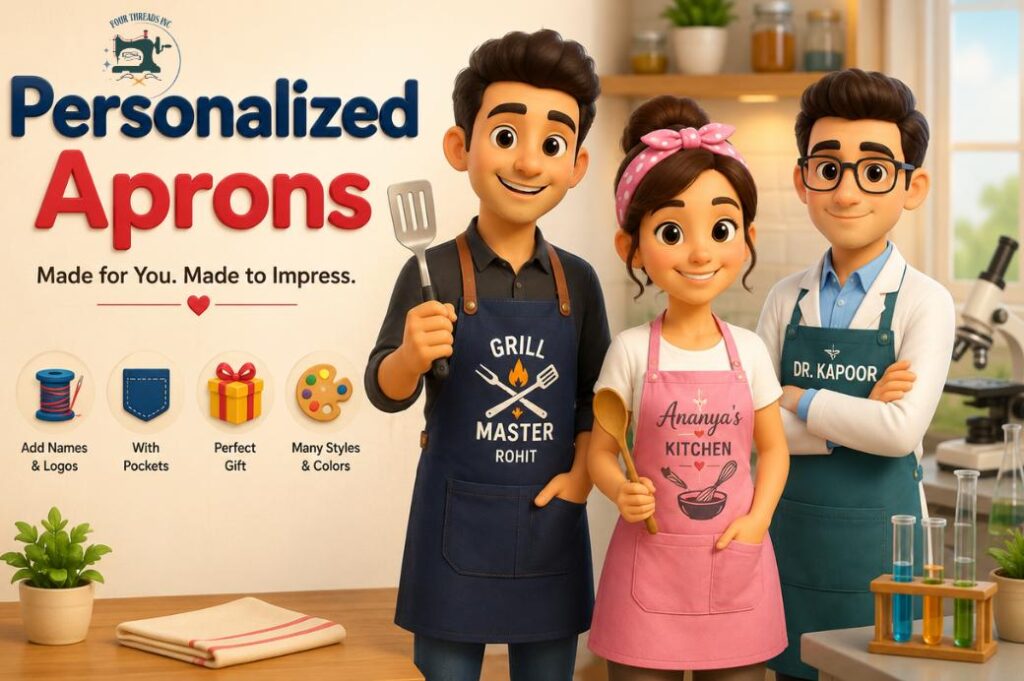
Across the varied landscapes of India, from the lively and colorful, spice-scented kitchens in Mumbai to the lovers of technology in the labs of Bengaluru, the simple apron has changed. It is not merely a garment kept beside the kitchen to shield one’s attire – it now serves as a medium for self-expression, a recognition of one’s profession and a practical and nice present.
So, are you a kitchen enthusiast who is on their way to the perfect butter chicken, a doctor who is the face of the situation even in the parts which are the most dangerous, or a small business owner who is developing his brand, the personalized aprons are like adding a bit of style and identity to one’s day-to-day life.
What Exactly Are Personalized Aprons?
If you haven’t heard about personalized aprons, it is a standard apron (usually worn over clothes to be protected) with a personal touch consisting of text, logo, picture, or design. Ultimately, the question they answer is “How can I make a standard apron uniquely mine?” To put it in Indian terms, one may want to personalize the apron by putting “Mrs Kumar” written beautifully in Devanagari style or a graphic of “Chai Master”. As a result, what was just a tool has been turned into a fashion statement.
Generally, the services of personalizing an apron may be divided into three major groups:
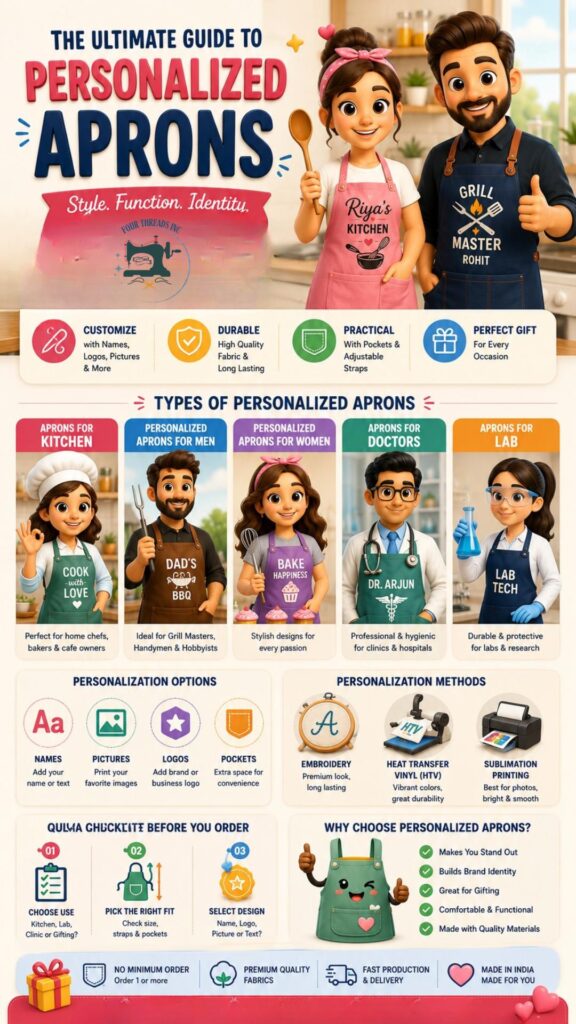
- Embroidery: Newest and most expensive of the three, and most long-lasting. Top speed machines are equipped with special threads that they sew right on the fabric to form names, monograms, or logos. Embroidery is suitable for chefs, doctors, or gifts to be kept for a very long time as it can last after many washings.
- Heat Transfer Vinyl (HTV): This method has been well-liked by those who engage in “do-it-yourself” and who have cutting machines like Cricut. It consists in cutting characters from colored vinyl and then attaching them to the apron by means of heat-pressing. HTV is suitable for brilliant colors and complicated designs.
- Sublimation Printing: This method is the most suitable for photorealistic and all-over prints. The ink is absorbed by the fabric and the product remains smooth and pleasant to the touch. Personalized aprons with pictures of family or pets is how one gets them.
The major point of differentiation between personalized and plain aprons is the feeling of closeness that personalized items produce. For instance, a “Papa’s BBQ Kit” or a new cafe uniform can make a person’s experience and sense of pride in their work go up substantially.
Choosing the Right Type of Aprons For Personal Use
There are various occasions an apron can be used for. It’s inevitable that each apron will not be suitable for each job. The type of fabric used, the measurement, and single or double sided printing must be in harmony with the user’s surroundings. Taking the Indian users who are concerned with heat and humidity as an example, they usually prefer light cloths like cotton or cotton-poly blends rather than heavy denim.
Aprons for Kitchen (Home & Professional)
Because a kitchen remains the largest domain for personalizing aprons, most Indian personalizing will be cooking oriented. Thus most of the home cooked Indian personalized aprons are made for festival cooking (Diwali snacks) or weekend baking projects.
Features: Ensure that neck straps can be adjusted, bibs are strong, and there are pockets. The demand for personalized aprons with pockets is mainly due to users wishing to keep their mobile phone (which can be used for viewing the recipe) or sampling spoons.
Personalization: A name like “Rohit’s Kitchen” or a fun caption like “Too Hot to Handle.”
Target Audience: Parents who want their child to learn to cook, home bakers who are creating small cake businesses, and BBQ lovers.
Personalized Aprons for Men (The Grill Master & Handyman)
Usually, men’s aprons are a bit different than women’s ones in terms of shape. They are usually longer (from mid-thigh down to knee) and wider so can offer the torso more coverage. Another feature is that these are designed with colors such as charcoal, navy, or olive green in order to be able to mask the stains from grilling or garage works.
Use Case: Could be one of the Father’s Day gift ideas, other birthdays, or simply a Sunday barbeque where the family “Grill Master” is honored.
Design Ideas: Embroidery work of a grill, a wrench, or an oversized “Kunal” in block letters.
Personalized Aprons for Women (Style & Contour)
Women’s personalized aprons are usually designed with an A-line or contoured waist style which makes them more flattering and less boxy compared to unisex ones. Also, they are mostly available in pastel colors (mint blush lavender) which are quite liked by Indian women for things like dinner parties or hosting art classes.
Use Case: When you are doing your gardening, painting, baking, or having kitty parties.
Design Ideas: Monograms (initials), floral embroidery, or script fonts.
Professional Use: Aprons for Doctors and Aprons for Lab
Besides kitchens, personalized aprons find great use in medical and scientific settings in India. Healthcare facilities, dental clinics, and pathology labs use them for maintaining cleanliness as well as branding purposes.
- Aprons for Doctors (Dental/Clinical): Though doctors may often be seen in white coats, Ayurvedic doctors and dental hygienists sometimes go for shorter aprons that are fluid resistant. Here, personalizing usually consists of small embroidered names or the clinic’s logos on the chest pocket. First impressions with patients are really crucial, and these personalized names and a professional look are sure to win their trust.
- Aprons for Lab (Scientific/Pharma): A completely different set of requirements is needed for lab work where the focus is chemical resistance. Those in the lab wear PVC or polyester blend aprons here which are of heavy-duty nature. Lab apron personalization is mostly through heat-sealed labels as embroidery can easily be damaged by chemical spills.
Key Requirement: Your personalization should not break the fabric and affect its qualities.
Indian Context: With the diagnostic labs quickly spreading in Tier-2 cities like Nagpur and Coimbatore, branded lab aprons have become a symbol of seniority among technicians as well as differentiating one from trainee.
Quick Glance: Your Final Checklist for Ordering
Use this pre-closing checklist to avoid the mistake of getting the wrong item after delivery.
1. Define the Use Case (Where will it be used?)
Action: Find out where you mainly will use your apron. Is it a hot kitchen where cotton would be the best choice, an art studio that needs polyester for stain resistance, or a formal clinic that demands professional, crisp fabric?
2. Choose the Personalization Method (Text, Photo, or Logo?)
Action: Pick the method that you want. Want something strong and enduring? Opt for Embroidery. Want a colorful photo of your pet? Go for Sublimation printing.
3. Pick the Right Fit (Unisex, Men’s, or Women’s?)
Action: Always consult the size chart. You should not rely on “one size fits all” notions. Also, try to find adjustable straps and suitable pocket placement. In case of doctors and lab staff, the logo should be placed on the upper left chest, away from the waist.
Conclusion
Personalized aprons have evolved from simply being a utilitarian item to a representation of modern Indian lifestyle where the lines between home, work, and personality are blurred. The “Masterchef” mom who wants a tough kitchen apron or the shrewd businessman who, with aprons for his lab staff, is building a brand, a customized garment is unparalleled in value. It is a way of low cost and high impact for showing love and care, building team spirit, or simply getting the opportunity to express your own style while making rotis or running a clinic. When you consider the qualities of base fabric and the personalization factor that matters the most, then the price will be quite secondary. For a flawless experience, Four Threads Inc has the knowledge and the custom options that will allow a box of cloth be made into an essential kept with great fondness.
FAQs
Yes, definitely. Many wholesalers insist on placing bulk orders but custom clothing makers, such as Four Threads Inc, are committed to “no minimum” policies for orders.
This can be great for single gifts, couple’s matching sets, or trial running a design for a small business.
This matter is often mixed up. The term “logo” stands for the design (the graphic symbol). “Embroidery” means the way that logo is done. Your company logo can be embroidered (stitched) on the apron or screen-printed (painted). Embroidery is a more upscale and longer-lasting way.
It depends on the printing method. If you use sublimation printing (where the ink becomes a part of the fabric), it is 100% machine washable and will not fade. But if you use regular heat transfer paper for photos at home, those may crack or peel after just several washes in an Indian washing machine. Always check the care label or request sublimation prints.
Usually, the first step is digitizing the design (the process of changing text/logo into stitch files), which takes 1-2 days, then comes the actual embroidery and shipping. For high-quality custom work in India, the lead time should be 5 to 10 business days however express options may be available for a higher price.
Leave a Reply