First impressions and operational efficiency are inseparable considerations in today’s competitive business environment. Workplace uniforms have indeed evolved beyond mere dress codes—they are an essential means of branding, safety, and performance enhancement of employees.
An industrial worker donned in protective clothing, and a customer service staff member displaying the brand are just two of the many ways uniforms affect operations and the perception of a business. Studies and industry reports are showing that uniforms lead to team solidarity, build customer confidence, and improve employee productivity through psychological mechanisms.
As companies want to be consistent and professional, it is necessary to understand the importance of workplace uniforms.
What is the importance of wearing a uniform at work?
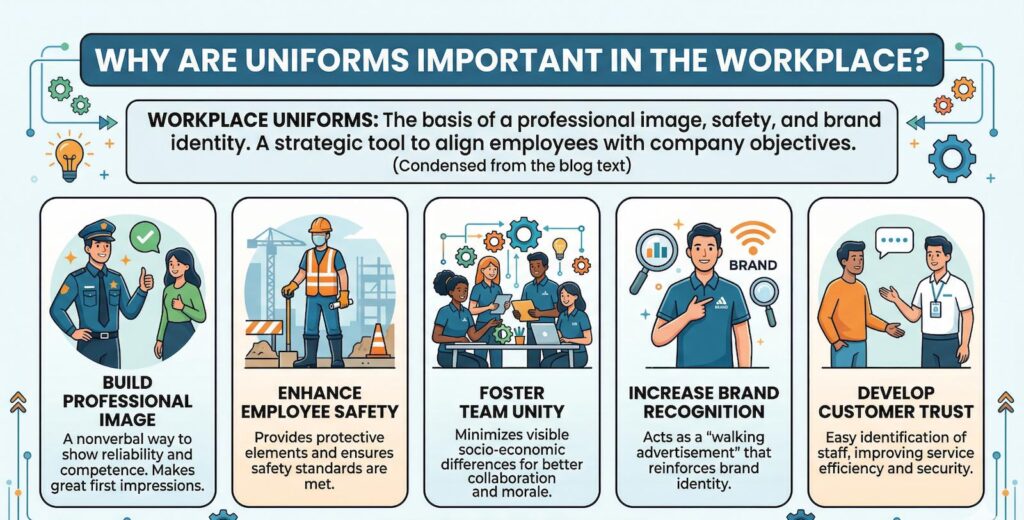
Workplace uniforms are the basis of a professional image, safety, and brand identity. Besides providing the appearance, they are a strategic weapon that helps the employees to be in line with the company’s objectives. Companies from various sectors, such as healthcare and hospitality, utilize uniforms to give a solid and dependable image.
Why are uniforms important in the workplace?
1. Professional Image & First Impressions
Uniforms are a nonverbal way of showing customers professionalism. Wearing standardized clothes means employees are reliable and competent, even before the dialogue takes place. This is a huge factor in the trust being a deciding factor in service industries.
2. Employee Safety & Protection
For example, uniforms in the construction or manufacturing industries come with protective elements such as a helmet, non-slip shoes, and high-visibility material. This prevents accidents at work and ensures that the safety standards are met.
3. Team Unity & Equality
Putting on the same clothes helps in developing a sense of union among the employees. It minimizes the visible socio-economic differences and devises a single team atmosphere, which leads to better collaboration and morale.
4. Brand Recognition & Marketing
Uniform is a “walking advertisement”. A person donning a branded shirt will be increasing brand visibility and at the same time reinforcing brand identity, wherever he/she may go, both within and outside the workplace.
5. Customer Trust & Security
Uniforms make it easy for customers to identify staff members. This not only improves service efficiency but also enhances security by preventing impersonation or confusion.
Uniforms ultimately help employees to be identified with the company, and that is why they are a very important part of workplace operations.
What are the benefits of wearing workwear?
Besides looking good, workwear can make a difference to performance, efficiency, and employee confidence. The companies that upgrade their staff with quality uniforms can expect a rise in both productivity and employee satisfaction of the employees. Workwear effectively eliminates the worries about making a good impression, therefore instilling a sense of confidence in the employees. Besides that, it is designed to facilitate the workday and smooth the production processes.
How does workwear improve employee performance?
1. Boosts Confidence
Workplace uniforms help the workers gain confidence in their roles. Aligning clothing with the job requirements leaves employees feeling more capable and prepared for carrying out their duties efficiently.
2. Enhances Efficiency
Clothing made for particular tasks not only eliminates distractions but also enhances the overall workflow. Ergonomic designs and pockets are examples of features that help the employees operate more smoothly.
3. Saves Time Daily
The daily archaic task of deciding what to wear is removed. Lessening decision fatigue results in employees being able to focus heavily on their job first thing in the morning.
4. Improves Focus
There is evidence that suggests that our attire influences our thoughts and actions. Uniforms that are associated with professionalism can be a factor in increased focus and discipline.
5. Encourages Accountability
Representing the company through one’s appearance leads to a sense of pride, responsibility, and accountability for one’s actions and customer interactions.
Workwear is, therefore, an understated yet mighty factor in influencing employee behavior and workday efficiency.
Why is workplace attire important?
Workplace uniforms’ importance is that the attire influences the entire business environment since it’s the very first thing that one notices. It is a reflection of the company culture, which defines the expectations from employees and the way in which employees and customers are interacted with within the space.
How does workplace attire influence business success?
1. Defines Company Culture
Uniforms that are formal indicate discipline and structure, whereas casual ones may show creativity. The choice of uniform is an immediate communication of the company’s values.
2. Creates Consistency Across Teams
Especially in big organizations or franchises, uniforms act as a common thread, providing consistency across numerous locations and therefore reinforcing the overall brand image.
3. Improves Customer Experience
Uniformed members of staff are seen as more approachable by customers. This shortens the customer service line and ramps up the service delivery where necessary.
4. Supports Workplace Discipline
Wearing a uniform represents a direct link to the company, thereby increasing the sense of discipline among the employees.
Workplace attire is, therefore, a visual language that communicates expectations, professionalism, and brand identity.
5 reasons why wearing a proper uniform is important
Uniforms make many contributions towards employee satisfaction and business development. These advantages go way beyond aesthetics but definitely touch every aspect of the operations.
What are the top reasons to wear proper uniforms?
1. Consistency in Branding
Uniforms make sure that every employee is a brand ambassador in the same way. This continuous reinforcement of the brand is very likely to ensure that the brand stays in the customer’s mind.
2. Cost Savings for Employees
Workwear saves the employees from having to buy a wardrobe solely for work. The additional benefit of this is that personal clothes suffer less wear and tear.
3. Enhanced Workplace Safety
The right uniform incorporates safety features specific to the role, minimizing risks and ensuring compliance with safety regulations.
4. Improved Team Spirit
Team uniforms are all about building rapport and are a wonderful way of removing work barriers, leading to a more inclusive environment.
5. Better Time Management
By removing the wardrobe dilemma, uniforms enable employees to get down to business quickly and efficiently.
The above reasons give an idea of the huge impact that uniforms can have on both operational efficiency and employee well-being.
Disadvantages of wearing a uniform at work
Although workplace uniforms offer numerous benefits, it is prudent to take note of the possible downsides in order to take a more balanced viewpoint. Organizations will be able to better implement uniform policies by identifying these issues.
What are the challenges of workplace uniforms?
1. Limited Individual Expression
Some employees may feel their personal style is limited. With flexible uniform options, this does not have to be a morale-damaging issue.
2. Initial Costs for Employers
Unavoidably, providing uniforms incurs initial expenditures. However, in the long run, they usually pay for themselves through branding and operational advantages.
3. Comfort Issues
Uncomfortable attire is usually a consequence of poor design. Using appropriate fabric and correct sizing can solve this problem.
4. Maintenance Responsibility
The employees will have to maintain their uniforms regularly, which might be inconvenient if the employer does not assist.
Even with these challenges, most enterprises discover that the positives significantly overshadow the negatives when uniforms are thought through and implemented effectively.
Wearing proper uniform at work & the consequences of not wearing it
Following uniform guidelines guarantees professionalism and uniformity. Failing to wear proper uniforms can have detrimental effects on operations and brand image.
What happens if employees don’t follow uniform policies?
1. Loss of Professional Image
Disparate clothing can give the impression that the business is unorganized and less trustworthy to the customers.
2. Customer Confusion
Without uniforms, customers may have difficulty identifying the staff, which can lead to poor service experiences.
3. Reduced Accountability
Employees may feel less responsible when they are not visibly representing the company.
4. Safety Risks
In certain industries, not wearing proper uniforms can lead to accidents or non-compliance with safety regulations.
Uniform rules help to keep the order at the workplace and inculcate discipline.
Choosing the right workplace uniform suppliers
Choosing the right workplace uniform suppliers is key to reaping the full benefits of uniforms. Quality, comfort, and branding all hinge on the supplier’s capabilities.
What should businesses look for in uniform suppliers?
1. Quality Materials & Durability
Suppliers need to offer top-grade fabrics that will stand the test of time without compromising comfort.
2. Customization Options
The elements of branding, such as logos and colors, should be customizable to fit the company’s identity.
3. Industry-Specific Designs
The supplier should know the unique needs of different sectors, such as safety features or functional designs.
4. Cost-Effectiveness
Finding a balance between quality and price is a must to get the best value for the business over time.
Working with dependable suppliers to get workplace uniforms can serve both functional and brand-related purposes.
Final checklist for the importance of workplace uniforms
- Ensure uniforms enhance safety and meet industry standards
- Maintain consistent branding across all employees
- Choose comfortable and functional designs
- Promote team unity and professionalism
- Partner with reliable workplace uniform suppliers
- Address employee concerns for better adoption
Today, workplace uniforms epitomize not only a dress code—they constitute a strategic resource that impacts the branding, safety, and performance of employees. When executed properly, they craft a professional, cohesive, and efficient working environment that is a win-win for both the business and the personnel.
Leave a Reply