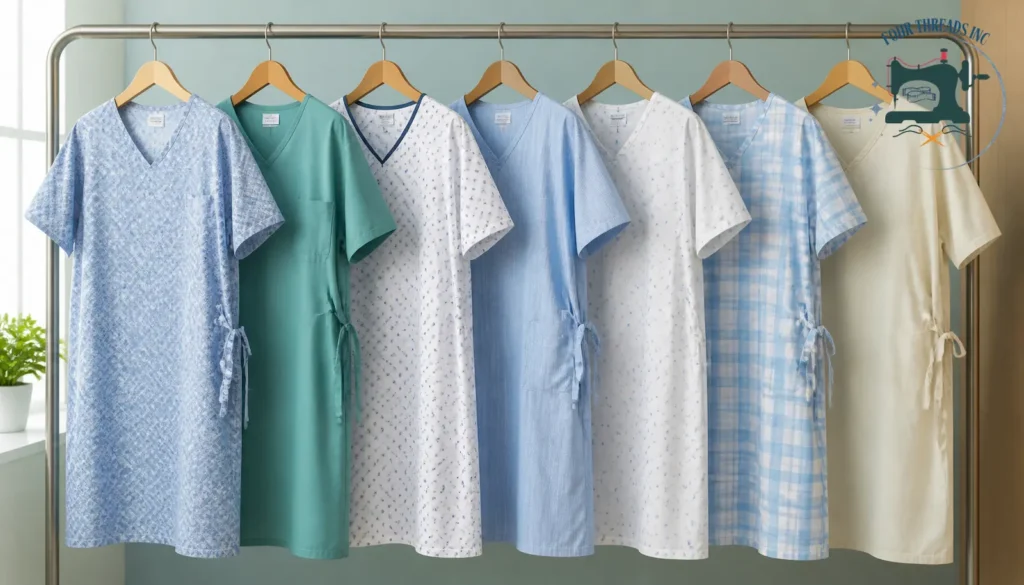
Hospital gowns are among the only medical products to be purchased by procurement teams, but assessed solely by patients. A thin gown does not perform its sole function — preventing fluids and microbes moving between a patient and those around them.
This is why standards like AAMI PB70 and EN 13795 exist: barrier properties are quantifiable. This complete patient gown guide explains the different types of hospital gowns, their functions and how to select the right one in a ward, operating theatre or for a long-stay patient.
What Are the Different Types of Hospital Gowns?
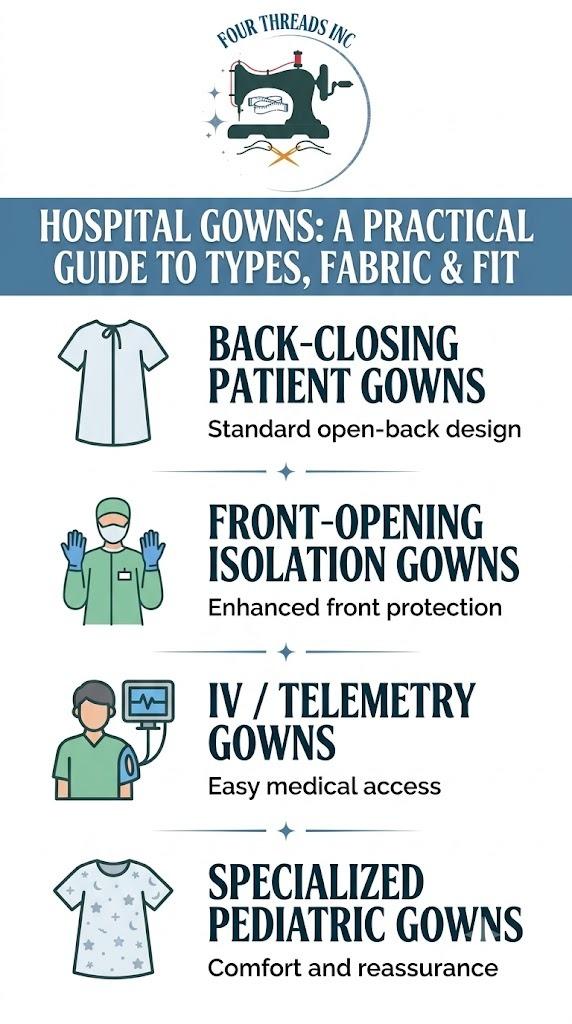
Patient gowns are categorized into three aspects — the barrier protection level, application, and disposable or reusability. It is unlikely that a hospital needs only one gown; a typical general ward, isolation room and an OT will need three different types of gown at the same time.
Which Gown Types Cover Most Hospital Settings?
1. Standard or Universal Gowns — These are light cotton or poly-cotton gowns, which are used on routine wards. These focus on the modesty and comfort of the patients over fluid resistance and because of this are used in the majority of ordinary beds in India.
2. Isolation Gowns — For contact/droplet precautions per CDC / HICPAC isolation guidance and require minimum AAMI Level 1–2 fluid resistance and full back coverage.
3. Surgical or OT Gowns — Garments placed in the sterile field for use during surgical procedures bearing either AAMI Level 3–4 or EN 13795. The chest and sleeve area have reinforced paneling to protect against strike-through.
4. Examination Gowns — Short gowns, which open at the front or back, used in out-patient departments and for diagnostic procedures. They are fast and easy to change and easy to wash.
5. Patient Comfort Gowns and Nighties — Comfortable unbarrier garments for extended stays. They sacrifice protection for breathability, fit, and dignity.
Correct category use first helps avoid the two most expensive errors with gown procurement: purchasing high barrier gowns where they are not needed, and purchasing low barrier gowns where they are.
OT Gowns for Patients: What Makes Them Different
The moment an OT gown is placed on the patient inside a sterile field, all bets are off. Any type of strike-through — absorbed fluid soaked through the fabric — might transfer bacteria into the wound. That’s why, unlike traditional fabrics, surgical gowns are hydrostatic pressure and impact tested, with the chest and forearms as the critical zones.
What Should an OT Gown for a Patient Offer?
1. Reinforced Critical Zones — Added dimension (spunbond-meltblown-spunbond — the ‘SMS’ layers) are added to the front panels and sleeves. These are critical zones that will be exposed to the most body fluids during the procedure.
2. Sterile, Low-Linting Fabric — Conventional lint can deposit itself on an open wound. A surgical gown is sterile and made to shed as few fibres as possible.
3. Knit Cuffs with Thumb Loops — Knitted cuffs will keep the glove nicely over the sleeve and thumb loops will prevent the sleeves from riding up when the surgeon moves.
4. Full Back Coverage with Secure Ties — In a wrap-around gown, no flapping open in the back. Tie-back and wrap-around styles keep the whole body covered.
The bottom line is that all of these are derived from the same reasoning that applies to all different types of hospital gowns, in that an OT gown cannot be a modified ward gown but must be a different product to a different spec.
Disposable Patient Gowns: Cost and Trade-Offs in India
Single-use gowns have the advantage of eliminating the need for laundry, which is a significant benefit in containment wards or busy OT lists. In India, the price of a disposable gown — polypropylene or SMS — is by a lot lower per gown than a reusable garment, which also incurs ongoing laundering and inspection costs.
Disposable vs Reusable Patient Gowns — How Do They Compare?
| Criteria | Disposable Patient Gowns | Reusable Patient Gowns |
| Upfront cost | Low — tens of rupees per piece | Higher — hundreds of rupees per gown |
| Laundering | Not required | Validated wash cycle and inspection required |
| Infection control | Single use, no indication for re-use | Based on laundering technique |
| Best suited for | Isolation, OT, short procedures | Long-stay wards, comfort wear |
Cost is half the story. Where you will be actually wearing it is the other half of the story.
Nighties for Patients: Comfort Wear for Long Stays
Nothing keeps a patient warmer than a patient nightie, and nothing interrupts a patient’s sleep more than discomfort from inability to move. Patient nighties are designed with that in mind — and to be worn comfortably when attached to monitors.
What Should Patient Nighties Get Right?
1. Front-Open Placket — For access to an IV line, central line or catheter without having to change the patient. Buttons or press studs are preferable to long-ties.
2. Breathable Cotton or Cotton-Blend Fabric — Keeps you dry during a fever, muggy ward conditions and extended periods in bed.
3. Elbow-Length Sleeves and Generous Length — Ensures the patient remains covered while sitting, walking to the washroom and interacting with visitors.
4. Laundry-Friendly Stitching and Colour Fastness — Hospital nightdresses are subject to heavy washing and at high temperatures, so the adequacy of any dye combination and stitch quality will determine their life.
Stylish Hospital Gowns: Design That Preserves Dignity
Back-opening gown: practical but revealing — not the sort of thing patients want to be seen in. More stylish hospital gowns improve coverage with well-designed prints, step up the coverage and have many sizes to match Indian builds — not one size fits all.
Do Stylish Hospital Gowns Affect Patient Experience?
They do, but in subtle, tangible ways. A neatly fitting gown boosts a patient’s confidence to get about, and to engage more fully with physiotherapy and dressing changes. The maternity, paediatric, and oncology wards are the quickest to take them up: patients there are admitted for longer, and judged on appearance. Prints and softer necklines, front-opening rather than back, and sizes up to XXL are the key features.
Quick Glance: Choosing the Right Hospital Gown
- Ward and comfort use — standard cotton gown or patient nightie
- Isolation and contact precautions — AAMI Level 1–2 isolation gown, single use
- OT and sterile procedures — AAMI Level 3–4 or EN 13795 surgical gown
- Short diagnostics and OPD — examination gown
- Long stays and maternity — front-opening, breathable, well-fitted printed gown
- Procurement check — verify fluid resistance, cuffs, ties, linting and size range
Gown choice is a minor buy that has an enormous impact on infection prevention, nursing time and patient privacy. Four Threads Inc offers hospitals, homes, and hospice care with patient gowns, OT gowns, disposable gowns and patient nighties by aligning fabrics, barrier levels and sizes to every environment so the perfect gown reaches each bedside.
FAQs
Isolation gowns give barrier protection from contact and droplet transmission and typically are AAMI Level 1–2 rated. Surgical gowns are sterile-field apparel assessed at Level 3–4 or EN 13795 and underwent testing for fluid strike-through in key zones.
Neither is a blanket improvement. Isolation and OT disposable gowns are preferred as they remove laundry as a risk, while long-stay comfort wear reusable gowns are best where a good wash cycle control can be ensured.
Comfort yes. Isolation or surgical use no — patient nighties are comfort garments and not barrier rated.
The majority are created with polyester, SMS (spunbond-meltblown-spunbond) fabric, cotton, or poly-cotton blends, based on the level of barrier and level of comfort required by the ward. For a deeper breakdown, see this hospital gown guide.
Leave a Reply