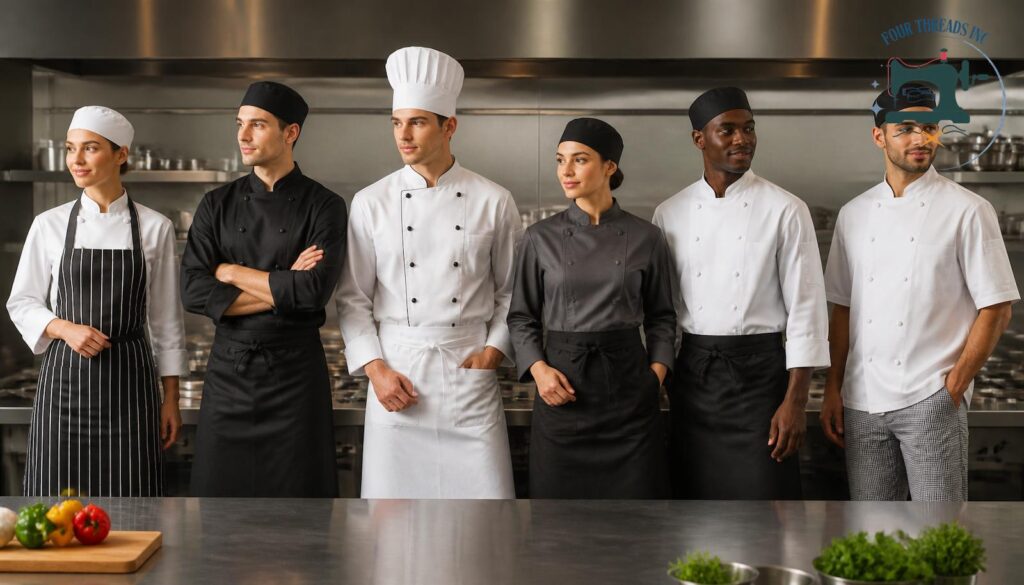
Entering a professional kitchen in India usually means seeing three or four quite different uniforms at once: full chef’s whites on the kitchen line, a short-sleeve coat at the grill, and an apron-and-tee combination at the wash station.
That is because a typical chef uniform comprises several components, from chef shirts and jackets to aprons and trousers, and each piece is chosen for its function, heat exposure, and the climatic conditions it will be used in. Through this article, you can get an idea of every kind of chef uniform and understand the components that make the right chef dress suitable for different kitchens.
What Are the Different Types of Chef Uniforms?
Chef uniforms can broadly be divided into two categories: traditional, which gives us the classic white set, and modern, which is based on kitchen role and decides whether the chef uniform needs to be heavy, long-sleeved, or formal. In most restaurants, chefs have a mix of both styles rather than following one strictly.
The Traditional Chef’s Whites
A chef’s white consists of mainly four pieces: a toque blanche (white hat), a white double-breasted chef shirt, black-and-white checkered trousers, houndstooth or other fabric patterns, with or without the apron. Its durability comes from the fact that every single piece serves a practical or health purpose — the shirt can be reversed to cover mid-service stains, the loose pants allow air passage, and the hat is the best way of keeping long hair under control. Hotel and fine dining kitchens still make this the norm for chefs in India.
Modern and Specialised Chef Uniforms
Modern kitchens have opted for lighter uniforms suitable for different roles. A short-sleeved chef jacket, for example, is perfect for a cooking room with a very high temperature; a coloured or branded chef coat helps chefs who are visible to guests; a chef wearing a shirt in a café may pair it with an apron or a personalized apron for guest-facing roles; and the dishwashing station calls for completely practical workwear.
In these types of chef uniforms, a bit of tradition must be sacrificed in return for the advantages of being breathable and easier to wash. Mostly, the decision about your choice of garment is governed by how many people your restaurant or kitchen is open to and to what extent your kitchen or team is exposed to heat.
Chef Uniform Types by Kitchen Role
Kitchen staff uniforms follow the same line of thinking as the brigade de cuisine that Auguste Escoffier helped formalise. The idea that rank decides what one wears has become the norm. This applies not only to standalone restaurants in India but also to the kitchens of large hotels. Obviously, the actual outfit may look somewhat different for each role, depending on the type of business or the level of customer served.
Executive Chef and Sous Chef Uniforms
An executive chef is most often the one to put on the most formal style of chef’s uniform, and they may also wear a name tag and a taller chef cap. Sous chefs often go for the same style as the executive chef, only without the name badge or taller hat. These are signs of professionalism, and if the kitchen is fully open, the executive and sous chef are often the first ones a new customer sees.
Station Chef, Commis and Line Cook Uniforms
Station chefs, commis chefs, and line cooks wear functional versions of the same jacket, usually lighter and/or short-sleeved. They are cooking over direct flames, so the breathability of the fabric is more important, and the fabric should hide stains better than show off formality. Comparing cotton vs poly-cotton chef shirts can help here. Kitchens normally use the same custom uniform design for all kitchen staff so they can switch between roles without changing dress styles.
Kitchen Porter, Dishwasher and Garde Manger Uniforms
Supportive roles are provided chef uniforms at their most utilitarian — waterproof bibs, aprons, gloves, and slip-resistant footwear instead of a full white outfit. Garde manger chefs are generally dressed in light jackets since they handle cold prep, so they sit halfway between two extremes. Water and slipping chemicals are the biggest problems here, so protection is prioritised more than appearance.
Anatomy of a Chef Kitchen Uniform
A chef’s full uniform covers from head to toe; it is a whole outfit, not a single piece. The purpose of every element mentioned below differs in the kitchen.
- Chef cap or toque blanche — contains hair and keeps it out of food. Taller styles are traditionally worn by senior chefs, which makes the hat a visible rank marker.
- Neckerchief — sits around the neck and absorbs sweat before it reaches the chest. It is optional in most modern kitchens and treated as a traditional add-on.
- Double-breasted chef jacket — the extra fabric layer protects the chest from spills and heat, and the front flap can be reversed to hide stains during service.
- Apron — shields the lower body from splashes and gives cooks a quick place to wipe their hands without reaching for a cloth.
- Checkered or houndstooth trousers — the pattern conceals grease marks, while the loose cut allows airflow during long shifts on hot lines.
- Side towel or duster — tucked at the waist so cooks can grab hot pans and wipe surfaces instantly, without searching for a rag.
- Non-slip shoes — the genuine safety component of the set, protecting against oil and water on tiled floors.
- Name tag — common in hotel and institutional kitchens to help staff and guests identify who they are speaking to.
Why Chef Uniforms Are Designed This Way
Chef uniforms are built around two core ideas: the protection of the chefs and professionalism. The double-breasted jacket is capable of absorbing heat to prevent the chef from overheating, and when it is heavily stained, the front flap can be reversed to hide the dirt. The white cotton or cotton-blend fabric is the kind that shows dirt instantly, so it gets washed often — a visible sign of hygiene standards being maintained across the kitchen department. Dark trousers plus a slip-resistant sole reduce accidents when working areas become wet.
As for professionalism, uniforms are a visual signal to customers and cooks that the chef is in a position of authority, and when uniforms remain consistent, apprentices feel proud to be part of the profession and develop a sense of belonging.
Traditional vs Modern Chef Jackets: A Quick Comparison
| Feature | Traditional chef jackets | Modern chef jackets |
| Fabric | Heavier cotton weave | Lightweight cotton blends, moisture-wicking |
| Sleeves | Long | Short or three-quarter |
| Closure | Double-breasted | Single-breasted, zip or snap |
| Colour | Predominantly white | Black, grey, coloured or branded |
| Best suited to | Fine dining, hotel kitchens | Cafés, cloud kitchens, humid climates |
Black Chef Uniform and Colour Choices
Restaurant kitchens and open kitchens that have switched towards modernity usually have chefs in black chef uniforms, mainly because the garments mask stains and grease more easily than lighter fabrics, and they also look sharp in photos shared on social media.
This means they also come at a cost of absorbing more heat. So, a black chef uniform in a hot and humid Indian kitchen must either be made of a very light fabric or have short sleeves. White remains the colour of choice mainly for fine-dining and hygiene-critical kitchens, while coloured coats often work as team or section separators.
Choosing the Right Chef Dress in India
Indian cuisines are very hot, they last long, and oil and spice usage is heavy, which makes the choice of fabric more important than the style of the garment. The ideal is to go for cotton-blend materials that are breathable or cotton that does not trap too much heat. For many Indian kitchens, that means breathable chef shirts with short sleeves, plus trousers that have an elastic waistband and strong stitching.
Our Four Threads Inc is dedicated to bringing the best chef’s working dress that meets this high professional standard. Our range comprises chef uniforms, aprons, and even the whole wardrobe set that withstands frequent machine washing on an industrial level. Most buyers evaluate materials on INR per piece, so our uniform cost calculator can help, and ordering sets with standard colours will save the cost of individual buying while also helping maintain uniformity throughout the kitchen team. If you are planning a bulk purchase, this guide to ordering custom clothes online in India can simplify the process.
Quick Glance: Final Checklist for Choosing Chef Uniforms
- Match the uniform type to the role, not just the kitchen.
- Prioritise breathable fabric if your kitchen runs hot.
- Confirm the jacket closure protects against spills and heat.
- Choose trousers and footwear built for slip resistance.
- Decide between traditional whites and modern colours based on guest visibility.
- Standardise sizes so replacements are simple.
- Check wash durability before placing a bulk order.
Kitchen staff uniforms are essentially functional pieces first and expressive clothing choices second. Chef’s white still reigns as the ultimate symbol of fine dish and hospitality, but in a new world, a modern chef’s dress adjusts itself to climate, one’s job, and how much one is visible to guests.
Go by the temperature in your kitchen, the jobs your staff do, and the number of times you will be changing the garments to choose the most suitable type. You can buy chef jackets, the whole uniform set, or only parts from Four Threads Inc, who design for real kitchen working conditions.
FAQs
Because the jacket overlaps in front, they get a second layer of protection from hot elements and spills, which can also be used to cover up stains during serving.
Yes. Black chef uniforms have become the go-to choice in sleek modern open kitchen concepts because they are stain-resistant. The downside is that they get hot faster, which is why one should preferably go for cotton materials or breathable chef fabrics.
1 reply on “Chef Uniform Types: A Complete Guide to Chef Attire and Kitchen Uniforms”