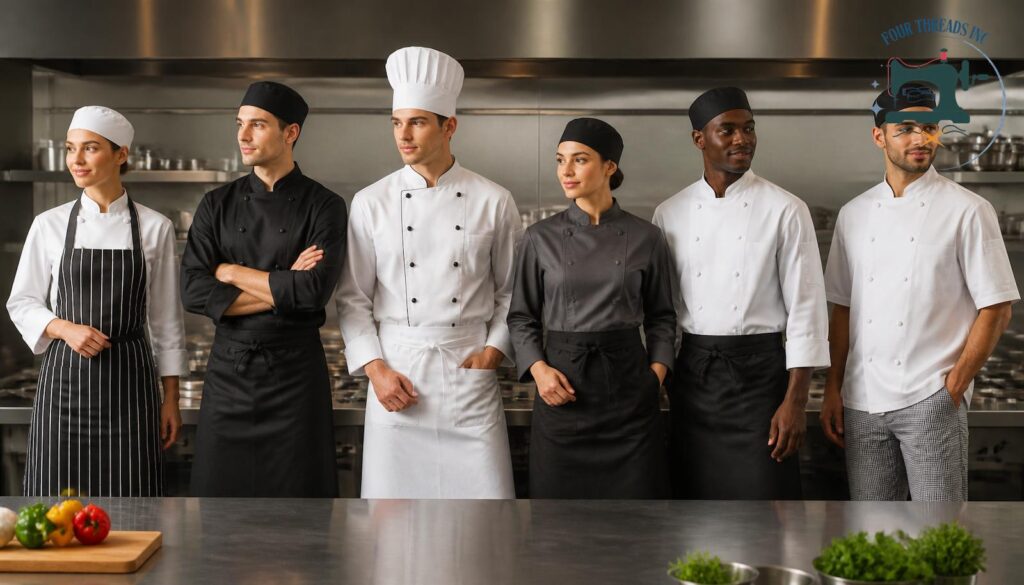
Chef coats face more stress than most restaurant garments: long shifts, oil splatters, and frequent hot commercial laundering. This is exactly why chef coat embroidery has become the way of the hotels, kitchen chains, and bakeries in India to put their name on staff uniforms.
Unlike a print, the embroidery of the thread is the fabric itself, so the branding often keeps on the coat longer. This article walks you through chef coat embroidery, compares it with printing, and gives you an idea of its cost in India.
What Is Chef Coat Embroidery and How Does It Work?
Chef coat embroidery is a method where one can stitch the logo of the company, the name of the restaurant, or a monogram through the use of a multi-needle sewing machine directly onto a piece of the fabric used to make a chef’s coat or chef’s jacket.
A print leaves behind on the surface of fabric as either ink or paper film, whereas embroidery creates a design with a surface texture made with thread. Logos or other details that are embroidered on hospitality uniforms can range from an emblem on the left chest of the jacket to the restaurant name on the sleeve or back yoke.
How Does the Embroidery Process Work Step by Step?
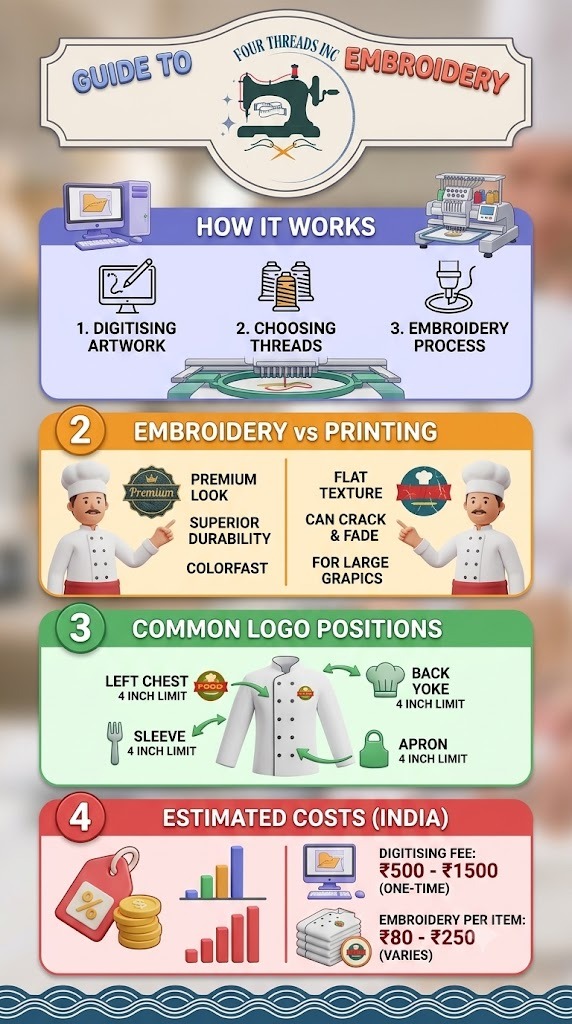
1. Digitising the artwork. A piece of artwork like your logo is turned into a file of stitches that indicates to a machine the position to place each little point of the needle. The initial cost for a design to be turned into a digitized file usually costs between ₹500 to ₹1,500, and that file can be used for every new order afterwards.
2. Choosing thread and backing. A special kind of colorfast polyester thread that matches brand colors gets selected with a cut-away backing, which is used to keep the fabric in place and the stitches from becoming puckered.
3. Getting approval on a sample. A test logo or embroidery will be made before a mass-produced batch is started.
4. Dyeing and finishing. Each jacket is mounted with tension in between the embroidery machines to prevent the fabric from being stretched or warped after sewing.
Embroidery vs Printing on Chef Shirts: Which Is Superior?
There is no one-size-fits-all. Choice depends on different factors including design dimension, number of colors, number of orders, as well as frequency of wash, particularly the coat in the kitchen.
| Factor | Embroidery | Screen printing |
| Look | Raised, premium texture | Flat, sits on the surface |
| Durability | Colorfast thread, often outlasts the shirt | Can crack, peel and fade under heat and UV |
| Best for | Small chest, sleeve and collar marks | Large back prints and multi-colour graphics |
| Cost logic | Higher setup, higher per piece | Lower per piece at high volume |
Does Embroidery Last Longer Than Print?
Yes, in almost all kitchen setups. As embroidery threads are worked into the weave of the fabric, the design is integral to the material and the very fabric of the garment rather than a surface covering that might lift off.
Also, colorfast thread prevents fading caused by UV light and repeated hot drying. As printing usually cracks along edges after many wash cycles, it is not unusual for chefs’ whites to look newer than their jackets.
What Are the Disadvantages of Embroidery?
Although a good method of embroidery work, embroidery is not the only solution for every order. These four major shortcomings are often mentioned:
1. Higher cost upfront. A non-refundable digitization of the design is charged before the embroidery starts, which would make the embroidery less cost-effective for just one single garment.
2. Not possible to have a color blend. Unlike printed media, thread cannot reproduce shades and color gradients or detailed photograph-like prints, which means very complex artworks are often simplified.
3. More heavy texture. A large number of stitches may add weight on such a shirt and make it stiff, which is quite the case when one is worn, for example, on an extremely lightweight summer jacket.
4. A long preparation time. Machine stitching means a larger quantity of work takes longer, while a small size presswork order finishes up quickly.
Which Is Better, Embroidery or Sublimation?
They address completely different needs. Sublimation printing is a way of dye that goes directly through to fibers, enabling full-color graphics with no additional weight, but it is not suitable for cotton or cotton-rich blends at all and it has to be pre-dyed on fabric.
Because most chef coats are cotton or cotton-rich, sublimation is hardly ever practical. Still, embroidery is the choice that would give greater satisfaction and lasts longer.
Which Printing Method Is the Best for a Shirt?
That really has to be judged using individual needs and preferences, and there may not be one method as the best printing way. Screen printing is cheaper for big flat print runs; DTF and heat transfer accommodate colorful details and small lots; only polyester can have sublimation.
A structured and properly fitted collared garment like a shirt or jacket is a perfect example of a printed piece that, to some extent, appears to be less expensive and flat, unlike being embroidered, which is a very good choice to get the premium finish.
Where Should the Logo Sit on a Personalised Chef Jacket?
The position is just as important as the process itself. The common areas on a chef coat to place a logo are the left chest, the sleeve, the back yoke, and the apron. The left chest is a good place for a 2-3 inch logo which is noticeable but not a disturbance while delivering service, while the sleeve can also be a perfect place to put your subsidiary element like a culinary school crest.
Limit your design size approximately to 4 inches wide and to about four or five-coloured thread; if the artwork is big like this, then it would be very suitable to be done with printing method.
What Does Chef Coat Embroidery Cost in India?
The price is different between cities, stitch count, and order size, but the trend is the same. Digitizing is a one-time charge for about ₹500 to ₹1,500. Embroidery per item for a small shirt logo is between ₹80 to ₹250 and goes up as the number of stitches per inch and the size of the design get bigger.
In the absence of having to make any screens or plates, embroidery doesn’t have any set minimum quantity. For instance, you get the same quality of work when you order ten chef coats as you would when you order five hundred coats.
Quick Checklist Before Ordering Personalised Chef Jackets
- Finalise placement: a main logo on the left chest and a secondary one on the sleeve.
- Make the design no more than 4 inches wide and use four or five thread colors.
- See a sew-out sample approved if any doubts remain.
- Check if digitising is done once-off or at every order.
- Refer to the wash instructions on the back of the coat and do laundry cycles only in neutral detergents.
Chef coat embroidery is the most durable type of kitchen uniform branding since the thread can withstand the heat, detergent, and wearing better than even the best surface prints. Match the embroidery location, keep the artwork simple, and your logo will last much longer than the kitchen uniforms themselves.
Four Threads Inc is here to assist your kitchen with logo digitising and sew-out approvals and to provide embroidery service in chef jackets even if you only order a minimum quantity like the 10-piece order as well as the 100-piece order that will have the coats leaving looking equally smart.
FAQs
Yes, that’s a safe way to do it. Colorfast polyester thread will stand up to normal or commercial laundering, even to hot cycles for kitchen whites. Just put the coat inside out and don’t get it wet with chlorine bleach as it will get the thread and fabric both weak and breakable.
Due to the nature of embroidery which doesn’t require the use of a screen or a plate, you can have a small amount and even single pieces without affecting the work. Though, you will need to have the digitising file first, which if the design remains the same and you have the digitising done you can reuse the file for all your subsequent orders.
On average, you can expect a sew-out sample to be ready for picking up within two to three days and a team of ten workers working with a stockpile of one hundred jackets would result in it being completed in approximately five to ten workdays according to machine capacity and stock.
Possibly, as long as proper backing is used. Less stitch density is required on delicate fabrics and a good stable cut-away backing will keep it flat and prevent puckering, so do discuss with the embroidery company about which backing is best for what kind of fabric before finalizing the design.
Leave a Reply