
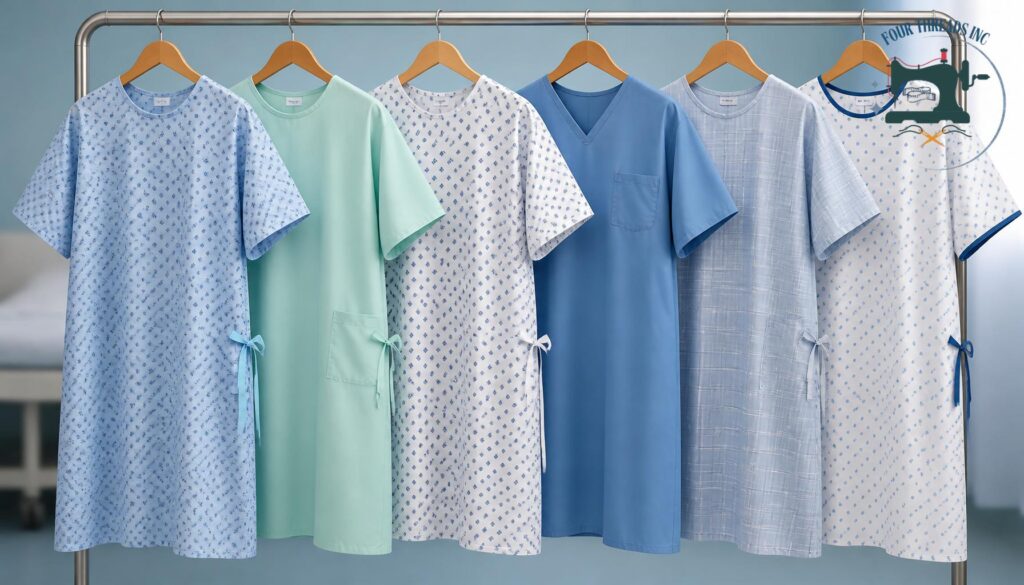
Millions of patients in Indian hospitals will have a back-opening gown put on each day, before a scan, dressing change, or operation. The World Health Organization believes that hundreds of millions of patients worldwide die each year because of health care-related infections. Every time a patient’s garment is changed, correctly laundered, and appropriately cut, it’s an easy barrier to reduce that number. A patient gown would be nearly insignificant as a thing to buy, had there not been unfortunate choices of fabric, GSM, and fastener for the hospital.
What Is a Patient Gown and How Is It Designed?
A patient gown is a gown designed to fit loosely and provide access for examination, scanning procedures, and life in the hospital ward. It is known by different names according to when, where, and why it is used, including hospital gown, examination gown, OT gown, and for the UK and parts of the Commonwealth, a “Johnny gown”. It is designed around three medical truths: every second counts, access for the treatment must be possible without taking clothes off the patient, and the occupant must remain comfortable even when inanimate for hours.
Why Are Hospital Gowns Open at the Back?
1. Faster changing during emergencies. A back-opening design with ties at the neck and waist allows a nurse to open a patient gown in less than 60 seconds, an important factor in the time-sensitive emergent and pre-operative bay setting. The patient does not need to raise their arms or twist their body — both painful motions after injury or surgery. In the hectic Indian tertiary-care hospital environment, this can be life-changing.
2. Uninterrupted access to lines and dressings. IV cannulae, urinary catheters, ECG leads, and abdominal dressings are all on the front, so back-opening gowns enable access without disturbing the patient. Usually, loosening a single tie tends to be enough to look at a surgical wound. For this reason, patient gowns are intentionally large, rather than fitted.
3. Ventilation and easier laundering. The loose weave of the cotton or poly-cotton permits air circulation, decreasing skin maceration while in bed during the sultry Indian summer. An absence of seams or metal fixtures means the garment is more durable for industrial laundering.
This underlying design logic informs the aesthetic preferences of buyers: it is the specific placement of the tie, the depth of the neckline, and the length of the sleeve, not the color or pattern printed on the material, that is so important.
Types of Patient Gowns: Female, Mens and X-Ray Gowns
Most establishments operate three or more different gown styles, and there are several aspects of design that need to be considered. These are practical rather than necessarily aesthetic. They include:
What Makes a Female Patient Gown Different?
Beyond providing modest front coverage, a female patient gown typically features a slightly deeper neckline and is longer so the hem falls below the knee. Many styles also include an extra waist tie and side slits that can be loosened for gynecological and obstetric examinations, making the gown easier to put on and take off. Maternity and post-natal wards commonly use a lighter-weight cotton and poly-cotton mix.
Choosing a Men’s Hospital Gown: Fit and Fabric
A men’s hospital gown is cut larger across the shoulders and chest and may have a longer torso so the fabric will stay put on taller patients. Longer ties are useful as they may be tied at the side or front for patients who are unable to reach behind themselves. For larger patients, ensure there are 3XL sizes available and the fabric is a weight greater than 140 GSM so the gown will not turn transparent.
X Ray Gown for Patients: Why Metal-Free Matters
An x-ray gown for patients has to be 100% metal-free — no snaps, zip pulls, or metal eyelets, as anything within the exposure field shows up on the image as an artifact, which can cause a repeat. So radiology gowns are secured with fabric ties, and some are manufactured from barium-free radiolucent material that does not affect the picture. This common design is often used on the ward for routine exams, so there is a greater number kept in stock.
Disposable vs Reusable Patient Gowns: Which Should You Buy?
This is the largest purchasing decision a hospital has to make, and often the answer comes down to turnover, ward type, and laundering facilities rather than purely price.
Indicative Cost Comparison in INR
| Parameter | Disposable (non-woven) | Reusable (cotton / poly-cotton) |
| Typical fabric | Spunbond PP or SMS, 20–40 GSM | Cotton or poly-cotton, 100–180 GSM |
| Indicative unit price | ₹15–₹80 per piece | ₹250–₹700 per piece |
| Upfront cost | Low | High |
| Running cost | Ongoing purchase, no laundry | Low after amortization, laundry cost applies |
| Wash life | Single use | Rated for 50+ industrial washes |
| Best suited for | Isolation wards, OTs, high-turnover ERs | Long-stay wards, OPDs, examination rooms |
| Disposal | Biomedical waste as per BMW Rules, 2016 | Negligible, after wash life ends |
What Do AAMI Levels 1 to 4 Mean?
The AAMI PB70 classification indicates the volume of fluid a barrier gown will withstand and is the most efficient means to directly compare two vendors:
1. Level 1 — minimal exposure. For routine patient care and isolation, no heavy splashes expected.
2. Level 2 — low exposure. This level has been used for blood removal, suturing, and IV line placement, where smaller amounts of fluid may have reached the fabric.
3. Level 3 — moderate exposure. Selected for arterial blood samples, trauma bays, and critical care units where large volumes of fluid are likely.
4. Level 4 — high exposure. Impermeable and tested against blood-borne pathogen penetration; used in infectious-disease wards and high-risk surgical procedures. Surgical gowns for sale in India also must meet EN 13795 sterility requirements.
Need a quicker 10-second test of quality? GSM is often related to a denser weave and superior opacity, but in fact, GSM is not the sole indicator of a barrier’s performance.
Final Checklist for Buying Patient Gowns
- Match the gown type to the department — radiology, maternity, ICU, and OPD need different specifications.
- Verify the barrier level before anything else: AAMI Level 1 for general care, Level 3 or 4 for high-fluid settings.
- Check GSM against expected use; 100–180 GSM works for reusable, 20–40 GSM for disposable.
- Confirm metal-free closures if the gown will ever enter an X-ray or MRI suite.
- Insist on sizes from S to 3XL, and ask whether custom sizing is available.
- Ask about wash-life test data if you are buying reusable gowns in bulk.
- Confirm disposal guidance aligns with the Biomedical Waste Management Rules, 2016.
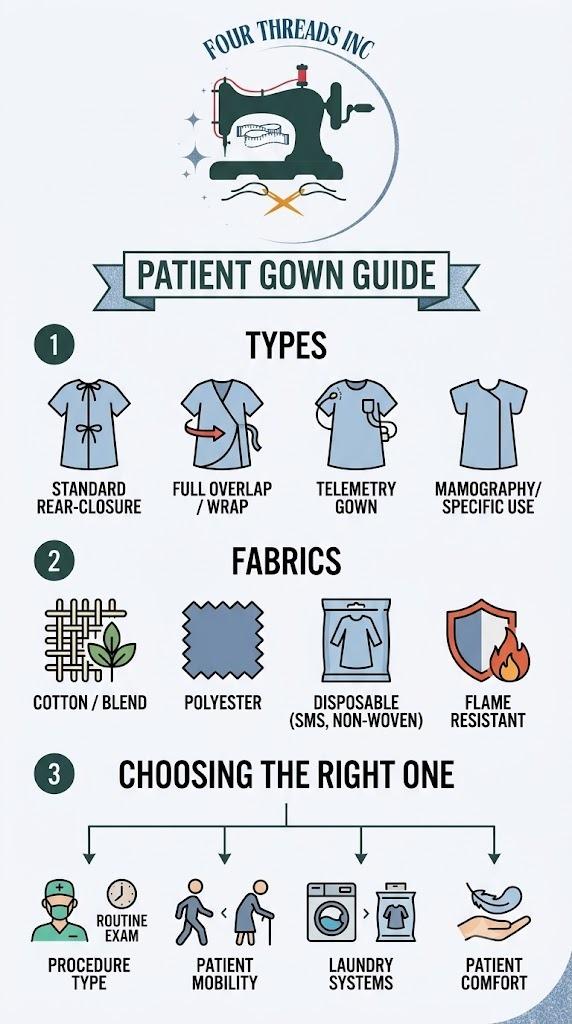
Final Thoughts
A patient gown is the low-hanging fruit for major purchasing decisions and comes through every department in the hospital – which, for one of the few purchases where small specification decisions can impact greatly on patient comfort and infection control, means every cent counts. Shop by barrier level, weight, and type of closure, not price.
Four Threads Inc offers these formats of patient gowns – washable, cotton, and poly-cotton gowns, disposable isolation gowns, and metal-free (suitable for radiology) options – and is able to customize a hospital’s requirement of sizing, closure type, labeling, etc.
FAQs
Reusable gowns are composed of cotton or poly-cotton mixed fabric ranging from 100 to 180 GSM. 20–40 GSM spunbond polypropylene or SMS non-woven fabric is used in disposable gowns.
Indicative bulk pricing in India runs from roughly ₹15 to ₹80 per piece for disposable gowns and ₹250 to ₹700 for reusable gowns. Barrier level, GSM, and order quantity move the price significantly.
Yes, reusable gowns are suitable for multiple times in industrial wash processes, often at 65–71°C when it comes to thermal disinfection, and most are rated at 50 or more wash cycles. Disposable gowns are too contaminated for thermal disinfection and must only ever be disposed of as biomedical waste.
Most large suppliers already provide small up to 3XL, and some provide a bespoke fit. For bariatric patients, select a fabric over 140 GSM to ensure the gown remains opaque and maintains its shape.
3 replies on “Patient Gown Guide: Types, Fabrics and How to Choose the Right One”