
What Are Front Opening Hospital Gowns and Why Do They Matter?
A front opening hospital gown is a patient hospital gown with its fastening (snaps, ties, Velcro, or zips) on the front rather than the back. For patients who are recovering from surgery, with an IV line, or just to keep your dignity in front of other people, a front closing gown eliminates having to put up with feeling exposed.
Our front closing patient gown is designed with the patient’s dignity, ease of putting on, and clinical convenience in mind. In India, where relatives often stay with patients in the hospital, it is not necessary for these relatives to have to find the way around a backless hospital gown to help the patient into a gown—a front closing gown only helps.
How Does a Front Opening Gown Differ From Traditional Hospital Gowns?
The main difference is the level of access provided, and the level of dignity preserved. Conventional gown halves, which open at the back, may require the patient to reach behind themselves to adjust tie strings (or for the nurse to do so), which can be painful post-operatively or with limited mobility.
Front opening gown halves keep the closure within the patient’s reach, allowing them to be easily donned without the need for movement in the shoulders. The portability of the closings brings this gown improved access for clinical examination and hospital monitoring equipment, while to care for wounds, irrigation, and bandage changes, the patient does not need complete disrobing. Nursing mothers can also benefit from front-opening designs. So, this gown has potential use in the maternity ward and during post-partum recuperation.
What Are the Key Features to Look For?
Some garments have styles of closures like snap buttons, Velcro, or ties, and all have their pros and cons. Innumerable hospital gowns are held together with snapping buttons; not only do they keep the gown closed, but they also stay secure.
When shopping for a hospital gown, make sure to get a feel for how the Velcro holds up for elderly patients. Ties are a versatile option that can easily be loosened and tightened, and they can usually be used by most body sizes.
Wrap Around Gowns: Adjustable Comfort for Every Patient
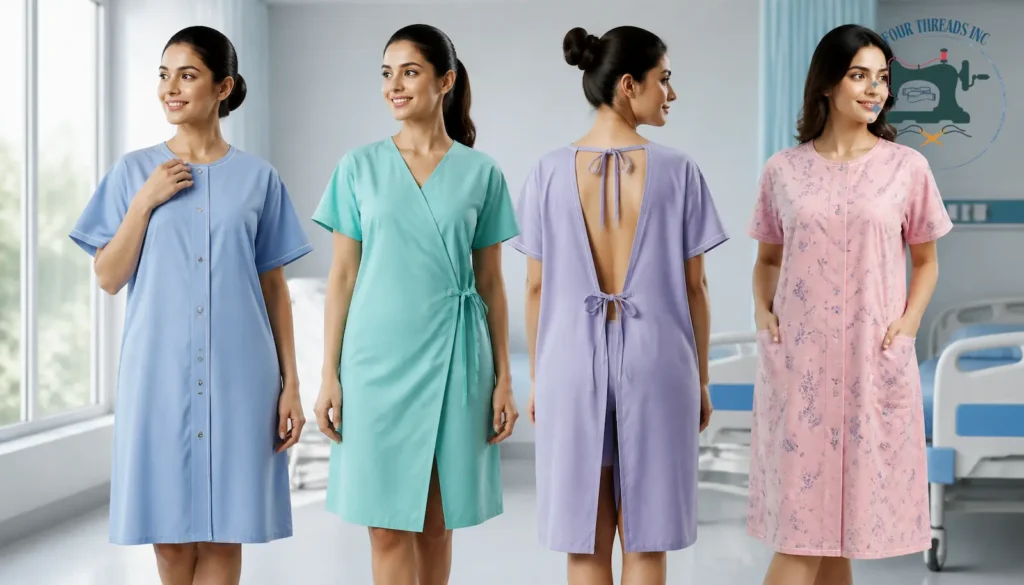
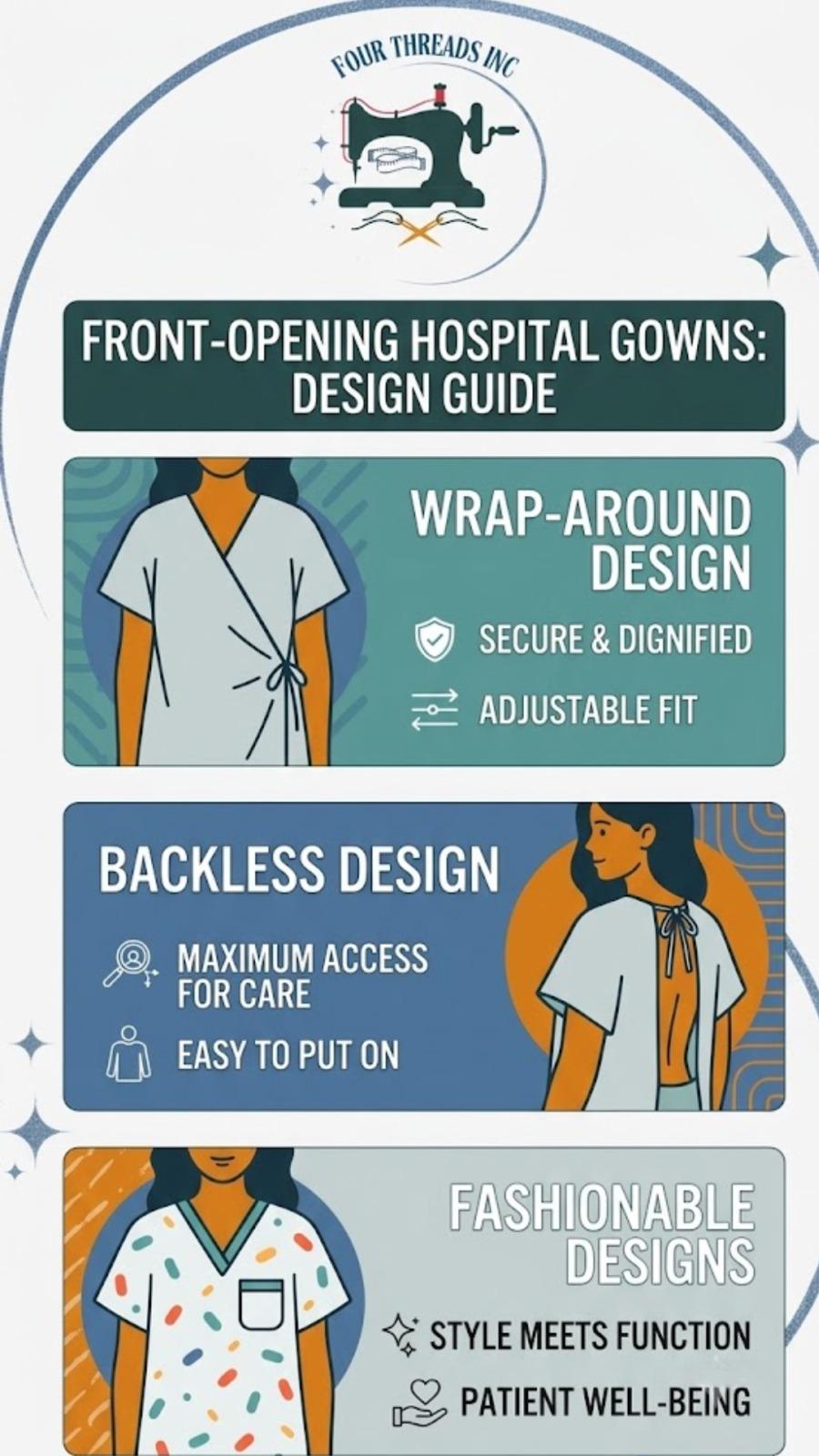
Wrap around gown – this is a style which has fabric cross over the front and is then fastened with ties or belts. They are adjustable to suit most sizes. It is most popular on a maternity ward and/or after surgery as a patient’s body shape may change during recuperation. The wearer has control over the coverage and the comfort of the gown without hindering access.
A wrap around gown with large amounts of fabric is very comfortable to multiple patients across Indian hospitals with variable numbers of patients. Wrap around gowns are quite versatile.
Why Choose a Wrap Around Design?
The front can be taken on or off easily, which is good for swollen post-operative patients or for patients who want a better fit. The Velcro front makes sure the patient is still covered up when breastfeeding is needed.
Patients also really like wrap around styles with only one fastener helping them get dressed. In one hospital with multiple departments looking for uniform gowns, wrap-arounds are one size fits all.
Fabric and Care Considerations for Wrap Gowns
For durability, hospital gowns are washed regularly in an industrial setting. Cotton wrap gowns provide breathability and comfort, but may shrink after repeated washings given the quality of the fabric—pre-shrunk cotton or a cotton-polyester blend solves that problem.
Infection control considerations include the ability of the gown to resist fading and weakening after high-temperature washes and application of chlorine disinfectants. Fabric that dries quickly also reduces turnaround time between patients, an important factor for hospitals that turn over beds regularly. A soft, lightweight wrap gown is more comfortable for a patient than a heavier-weight material when used in a personal setting such as a hospital stay.
Backless Hospital Gowns: Clinical Access Meets Practical Design
Backless hospital gown – this type of gown has an opening in the back with round pegs or ties at the neck and waist. It gives full access to the back for examination, insertion of procedures or tubes, and all other procedures a clinician may need. Although the traditional design of this gown is used widely, fashion designers are creating contemporary backless gowns that include more thought to soft materials and design, with the inclusion of reinforced ties and roomier dimensions to lessen irritation to skin.
This backless gown is also used during surgical procedures on the back or due to the nature of procedures requiring full access to the back, such as spinal procedures or diagnostic tests.
When Are Backless Gowns the Right Choice?
Backless gowns are essential for any procedure involving access to the back, for example when providing epidurals, lumbar punctures, or during preparation for spinal surgery. They are also used routinely for some imaging procedures and when the doctor needs to see the patient’s back clearly during a physical examination.
In these circumstances they make life easier for the medical team as it minimizes the number of times the patient has to hold their gown together or reposition it. Patients generally find a backless gown uncomfortable for longer periods as drafts can be uncomfortable and the patient often has to keep the gown closed when moving.
Balancing Clinical Needs With Patient Dignity
Hospitals are now understanding that dignity has an impact on a patient’s recovery and their overall satisfaction. It is important that although backless gowns have a valid and specific role in clinical practice, what patients prefer should be supported by designated ward use of front-opening gowns, with backless gowns being only available for specific procedures. Some hospitals surveyed provide a combination of the two, with the patient being able to decide which one they prefer based on their procedure.
Fashionable Hospital Gowns: Bringing Style to Patient Care
Fashionable hospital gowns have become a new trend, one which in particular appeals to maternity patients concerned with feeling good about themselves during labour, delivery, and postpartum recovery.
Designed with colourful prints, refined shapes, and soft fabrics that recall pyjamas or nightgowns rather than hospital mattresses, stylish hospital gowns have become very popular for a large market. As the sharing of “labour photos” has increased, women want photogenic hospital gowns of which they will be proud. Such gowns are now becoming popular in India.
What Makes a Hospital Gown Fashionable?
Modern hospital gowns usually unite functional attributes—front-opening, convenient IV access, breastfeeding-friendly—and aesthetic considerations—modern prints, colour-blocked panels, and comfortable breathable fabrics.
Some styles include hidden pockets for a phone, adjustable ties that can create a better fit, and extra length for coverage. The trick isn’t just to choose a stylish gown — it also has to work: a beautiful hospital gown that makes it more difficult for clinicians to perform their tasks isn’t very useful. Choose gowns that have the style without compromising the function.
Choosing the Right Gown for Labour and Delivery
Delivering mothers need an access opening in the gown for epidural administration, easy access to breastfeed, and sufficient coverage to walk around during early labour. Since the gown will likely be stained, it would be preferable to have a darker colour or a busy print. The material should be soft with a lot of stretch to conform to the changing body during pregnancy.
Some women bring their own gown to the hospital to feel more self-assured and attractive while in labour—Four Threads Inc has designed fashionable hospital gowns for use during pregnancy.
Quick Checklist for Choosing Front Opening Hospital Gowns
- Closure type: Snaps for security, Velcro for ease, ties for flexibility.
- Fabric: Cotton (breathability), poly-cotton (wrinkle resistance and durability).
- Availability of different sizes to cater to all body shapes.
- Clinical access: Check IV line, catheter, and monitoring compatibility.
- Dignity characteristics: enough overlap, long enough, and comfortably fastened.
- Washing instructions: make sure the gown is washable in the laundry cycle your hospital uses.
- Budget: Weigh initial costs against lifespan and the number of replacements.
- Supplier reliability: Find out about lead times, return policy, and customer centre support in case of problems with suppliers.
Conclusion
The evolution of hospital gowns has come a long way these days. Patients, caregivers, and hospital staff all benefit from the combined fashion, functionality, and ease of care presented by front opening hospital gowns.
Whether you’re shopping for a wrap around gown with adjustable fit, a backless hospital gown for a particular hospital procedure, or hospital gowns for maternity purposes that look good and wear comfortably, the right gown for you will make a positive difference in your hospital experience.
Questions about where to buy hospital gowns in India? Online marketplaces, specialty hospital clothing retailers, and direct-to-consumer brands offer a range of options for purchase. Four Threads Inc specialises in comfortable, uncomplicated hospital gowns that work – for patients and front-line staff.
FAQs
Rs. 300 – Rs. 1500 for individual front opening hospital gowns in India that can be purchased both online and in store, based on quality of fabric, style offerings, and brand. Simple cotton gown prices begin at Rs. 300–500, but fashionable and designer front opening hospital gown prices with higher quality fabrics and prints can cost Rs. 800–1,500.
Yes, hospital gowns can be washed many times in a single washing solution. Machine wash with a wash cycle using a mild liquid soap, and tumble dry on low to retain the durability and strength of the garments; they can last for hundreds of cycles.
Front opening gowns are effective for all types of surgery and recovery, in particular for surgeries involving the chest, abdomen, and extremities.
In cases where full access to the back is needed—for example in spinal procedures or some epidurals—a backless gown may be required. Most hospitals will have a backless gown available.
Hospital gowns usually are available in sizes from small to XXL, although some manufacturers produce one-size-fits-all or unisex gowns. If purchasing a gown for personal use, you should select your usual size so that you can wear the gown comfortably, or a larger size if you like a looser fit. If you are purchasing a gown for maternity, base it on your measurements during the third trimester so that you are able to wear the gown until delivery and during postpartum recovery.
Not if you buy from a good source. Good quality trendy gowns have all the clinical base covered—front and back opening, IV access, breastfeeding potential—without compromising aesthetics with prints and designer fabric. The trick is to go with a company that is familiar with the requirements from the medical perspective, like Four Threads Inc.
Leave a Reply