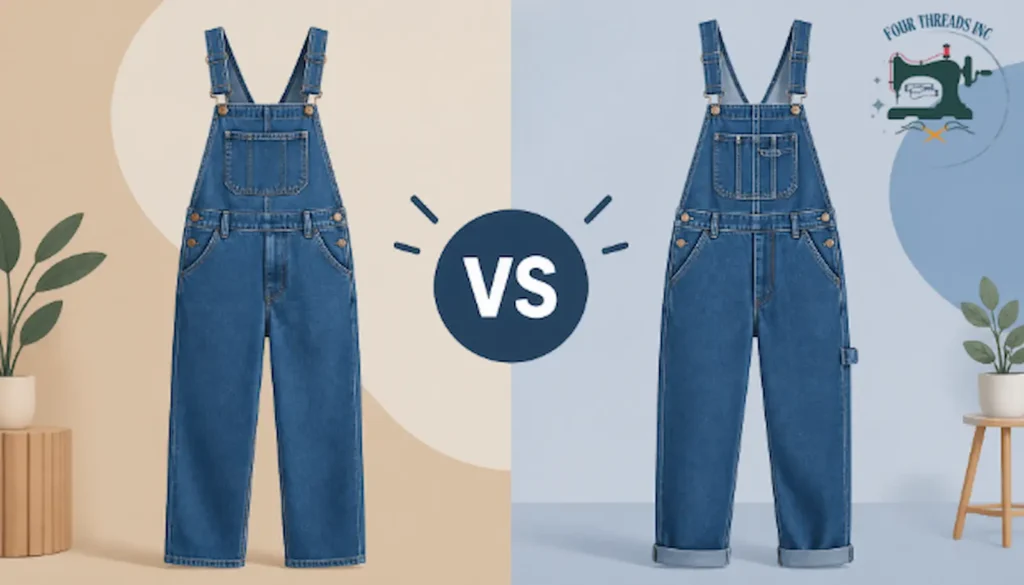
The dungaree vs overall question confuses people because the same word can mean different things by region. In Indian English, “dungaree” typically means denim jeans, while in the UK, it’s a bib-and-brace overall. “Overalls” in the US tends to be synonymous with that sleeveless workwear in the previous sentence. And it’s that regional divide that throws us off every time.
What Is the Difference Between Dungaree and Overall?
That’s the easy part. Dungarees and overalls actually are the same thing most of the time: a sleeveless bib front held up by shoulder straps over the top. The main distinction is simply vocabulary. In the UK, “dungarees” is the regular word; in America, “overalls” is, and in India, “dungaree” often translates as jeans.
US, UK and Indian English Terminology
| Region | Dungarees usually means | Overalls usually means |
| UK | Bib-and-brace garment | Workwear or same garment |
| US | Historical denim trousers; sometimes overalls | Bib-and-brace garment |
| India | Denim jeans | Bib-and-brace garment or workwear |
What Does “Bib and Brace” Mean?
“Bib” is the chest panel; “brace” is the British term for suspender-like shoulder straps. When the same construction is used, the weight goes on the shoulders, the overalls don’t fall down and the waist can be looser. When we explain dungarees and overalls in the same way, it’s because fabric and fit matter more than the label.
Once you have discarded geographical differentiation when it comes to actual construction, dungaree vs overall is obvious: the bib, straps, and sleeveless sides are the defining features of the traditional workwear version.
The One-Piece Family: Overalls, Coveralls and Boiler Suits
Dungarees and overalls are part of a larger “family” of one-piece workwear. There is understandable confusion because coveralls, boiler suits and jumpsuits are all full-body garments too, but they are differently tailored and have different usage.
Coveralls
Coveralls are one-piece garments with sleeves covering the torso, arms, and legs. Coveralls are used for painting, mechanic’s work, factory work and protection over other clothes. Bib overalls are not the same thing as coveralls because they do not have sleeves and are open in front.
Boiler Suit
The words “boiler suit” are almost interchangeable with “coveralls”, most of all in English of the United Kingdom. The origins of the term are derived from the boiler-room workers and the term is used in utility fashion to this day. It is not a dungaree because it lacks the open-sided bib and shoulder-strap design.
Where Does “Dungaree” Come From?
“Dungaree” is derived from *dungri*, a coarse cotton fabric of Dongri in Mumbai and maritime trade.
It actually spread from sailor and workwear clothing into British and American English. That story is why the same word can mean material, workwear, and jeans in different regions.
When Were Overalls Invented?
References to bib overalls are based on workwear for industrial and farm applications in the late 19th century, but patent dates vary by manufacturer. Bib overalls began as protection for over-garments but over time became everyday workwear. Today’s bib overalls retain the bib, straps, tool pockets and rugged cotton or denim.
What Is the Main Difference Between Dungarees and Jeans?
Jeans are a type of denim trousers with a waistband, fly, and belt loops; the term is restricted to such a standalone bottom. Dungarees (or overalls) are a bib-and-strap overalls-type garment worn over a shirt and/or T-shirt. The confusion can be from Indian usage and older US usage, where “dungaree” is frequently a synonym for denim jeans.
The explanation and the jeans analogy both demonstrate the main point: dungaree vs overall is a word puzzle first, a clothing puzzle second.
Are Dungarees in Fashion and How Do They Fit?
Dungarees cycle in and out of workwear trends and more recent old-school styles (think 1990s nostalgia and Y2K references) in waves. Their contemporary market is vast, with fabric options like denim, corduroy, cotton, duck and linen making fit and fabric really matter.
Are Dungarees in Fashion?
Yes, but on a cycle, not as a permanent reality. Dungaree dresses, pinafores, wide-leg denim and casual overalls pop up in street style time and again. In Indian wear, lighter denims and airy cotton styles are easier to wear throughout the seasons.
Is There a Difference Between Male and Female Overalls?
In women’s overalls, you may notice that the rise is shorter, straps narrower or adjustable, and the waist is shaped with side fastenings. Men’s overalls tend to have a longer rise, wider straps, and a roomier leg. Check to see if you can find a unisex fit these days for more options.
Types and Fit Guide
- Slim and skinny: fit through the leg with a slim ankle opening; stylish for fashion but tight for working.
- Regular or classic: straight and comfortable – closest to traditional workwear and good for layering.
- Wide-leg/relaxed: wide in the thigh and hem; best for casual styling and hot weather.
- Dungaree dress or pinafore: a bib top, without sleeves, added onto a skirt; a classic easy-to-wear womenswear piece, great as a layering item.
Fit decisions make the dungaree vs overall debate a real shopping decision for the fashionable as well as the working person.
Final Checklist for Dungaree vs Overall
- Look at the area: UK dungaree, US overalls, Indian dungaree often jeans.
- Verify the construction: bib and straps meaning overalls or dungarees.
- Check the sleeves: sleeves normally refer to coveralls/boiler suits.
- Examine the material: denim, cotton duck, corduroy, or linen.
- Check the fit: rise, inseam, strap length, and leg shape.
Long story short, dungarees and overalls are often the same sleeveless bib garment by different names. Four Threads Inc assists buyers and brands by highlighting the importance of construction, fabric, and fit so a label won’t be mistaken for the garment. Use this checklist before shopping or designing workwear.
FAQs
The navy suit is the more conservative business, interview, and daytime wear choice because it’s the most versatile and most flattering. The black suit is best for very formal evening functions, funerals, and anywhere you really need to look the part and demonstrate authority.
Navy blue or charcoal grey are the best colours for a business suit. Following a debate about the best colours for a business suit, navy blue and charcoal grey came out tops. Both are classic, professional, and work all year round.
A navy blue suit is considered the most universally accepted and classic business-professional colour. It is well-suited for conservative fields such as law and finance, and is also appropriate in modern business casual settings.
While a black suit suggests a more authoritative presence, it can also be perceived as too formal in a business environment. It’s more suitable for evening work events or in cases where a more authoritative image would be advantageous (e.g., a lawyer in the courtroom).
Avoid wearing a black suit at a daytime wedding. Wearing a black suit at a daytime wedding can appear too formal or sombre; go for a navy blue or a light grey suit instead.
1 reply on “Dungaree vs Overall: What Is the Real Difference?”