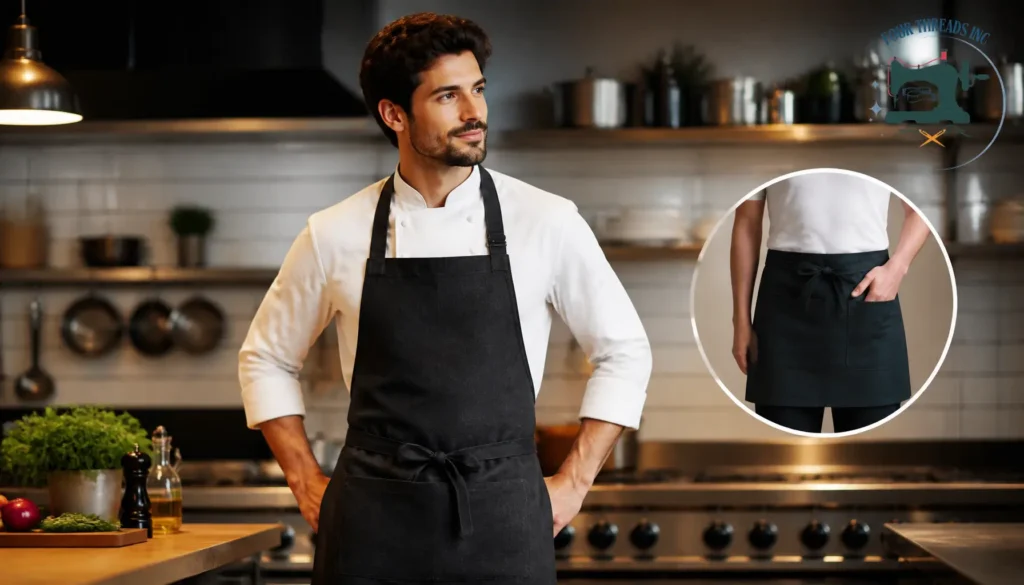
If you’re a chef, a home cook, or managing a restaurant, very few other choices of garments will directly affect your daily routine as much as the apron. A bib apron — that is, an apron with a bib which guards your entire upper body — is widely used among chefs. Though, waist aprons, in particular for serving staff, are their other great choice.
So, what makes a difference between one and the other and which one is the right choice? We have outlined some differences you can read about below.
What Is a Bib Apron?
A bib apron is a garment that fully covers the chest and goes down as far as the knee, leaving the upper torso, the lower portion of the upper garment, and the area of the thigh protected. The essential characteristic is that it has a “bib” — the part of the fabric which starts from the waist and extends up to the chest, very much the same as a baby’s bib but much, much bigger for actual cooking in the kitchen.
In addition, a majority of bib aprons have one or even two big front pockets which are either rectangular or square in shape, which were originally meant for holding kitchenware like thermometers, knives, and cutting boards. Today, it is also a place where some chefs put their towels and other small tools they may need when they are cooking. The reason why a bib apron is such a top choice among kitchen and service professionals is this combination of good coverage and functionality.
Bib Apron vs Chef Apron: Are They the Same Thing?
A lot of people use “chef apron” and “bib apron” meaning the same thing. But in fact, “chef apron” is a broader category and it could include waist-tied designs without any upper body covers.
A bib apron, then again, must have the cover panel for the chest area. So, if you are looking for a chef bib apron, you are selecting the version that gives complete protection to your upper body and is best suited for cooking and food preparation purposes.
What Makes a Bib Apron Different from a Waist Apron?
A waist apron — which is often used interchangeably as a half apron or server apron — can be tied around the waist and hips and it covers only the lower part of the body. While the bib apron covers your chest and abdomen, the waist apron leaves your upper garment completely exposed. As a result, the style that suits particular job requirements, work environments, and the comfort of the person wearing the apron is different for these two variations.
Coverage: Full-Front Protection vs Lower-Body Coverage
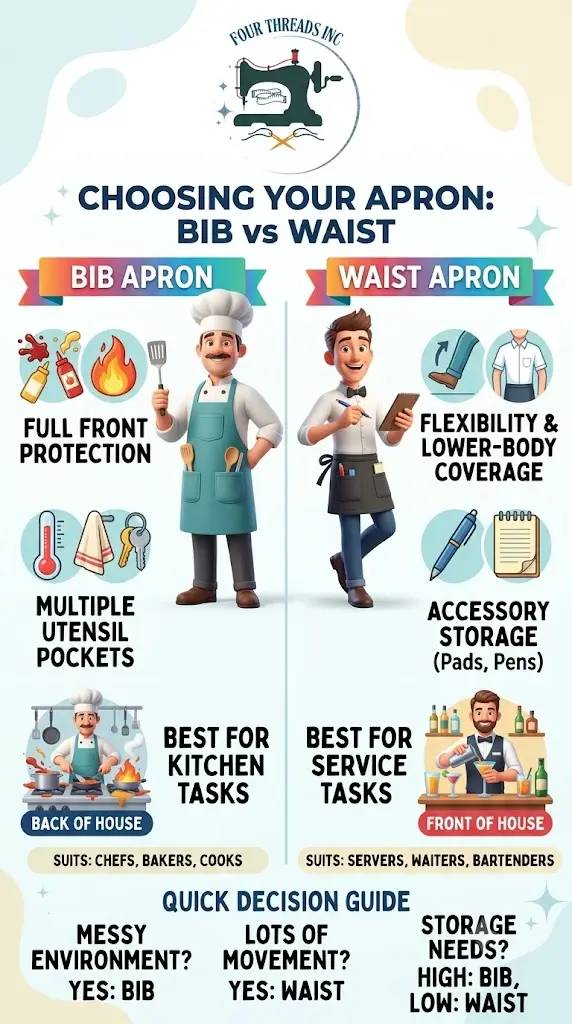
Bib aprons are the type of aprons that will protect the whole of your front from chest to knee and this is why they are used for a number of messy kitchen tasks like frying and preparation of sauces as well where splashes are most likely to happen.
Whereas waist aprons just cover the space below your waist so that you can wear one at work where you do not work with splashing liquids as much, and so, a waist apron would be a better option. In case you frequently lean over hot cooking pots or you are around a source of spatter, a bib apron is going to give you much better protection than a waist apron.
Mobility and Comfort: When a Waist Apron Wins
When your job demands a lot of standing and moving, a longer apron is not only a discomfort but also a source of perspiration and heat. Waist aprons are not bulky, they are airy and allow for maximum leg movement, so they are often favoured by people serving tables.
In many professional chef circles even, mostly if a high temperature is causing discomfort, one sees cooks switching to a waist apron. The reddit communities regularly feature discussions, such as those in the subreddit “KitchenConfidential”, discussing this issue: a full apron will protect your body from burns and splatters, but a shorter one will leave you cooler and more agile.
How Does Your Kitchen Role Influence the Choice?
Rather than going with what is just in your preference, a restaurant and commercial kitchen typically go with a kind of apron matched with the job duties that a staff member is going to perform.
Back-of-House Staff: Bib Aprons Offer Essential Protection
Bake, chef, or kitchen hands are working with oil and other dangerous foods on a regular basis that could spill causing injury to clothes or skin. A bib apron is able to shield one from these hazards with a double side coverage and keep clothes safe and clean from spillage. A big feature of bib aprons to which the chefs point out is that they have a number of pockets on the front of their clothes where essential items can be placed very close to them.
Front-of-House Staff: Waist Aprons for Serving Professionals
Waiters, hosts, bartenders — their requirement doesn’t include chest or knee covering. They need a lot of flexibility and some space for storing stuff like pencils, pads, or order slips at handy locations. A waist apron does it all and it also adds to the professional image. Unless your duties are centered in the area of kitchens rather than dining, a waist apron will be the most fitting decision.
What Fabric and Colour Should Your Bib Apron Have?
When settling on the bib style, don’t forget that the material and the color are equally important as the shape. A good fabric can make a great difference for breathability, lifespan, and the ease with which an appliance can be kept clean after repeated usage.
Cotton Bib Aprons Are Built for Everyday Kitchen Use
Home and professional chefs alike love to wear cotton bib aprons because they are the kind of material that is soft, breathable, and absorbent. If you are looking for a heavy-weighted, tightly woven cotton that can still remain comfortable even during the hottest hours, a heavy-weave cotton might just be perfect.
Also, the color of the apron matters. For instance, many restaurants choose black bib aprons because this color effectively hides the stains and grease marks, and so, the uniforms or the staff look neat even after the most hectic service hours. As a result, canvas, denim, and cotton-polyester mixes can be considered for durability and resistance to creasing, but with daily wearing comfort, cotton as a fabric is the most comfortable.
Quick Checklist: Choosing Between a Bib Apron and a Waist Apron
Before a new apron purchase, think twice and compare the apron you need to use with a list of what you really need.
- Assess your work environment. In case of splatter or sauce-related spills or in case of your workplace getting messy a lot, opting for a full-length apron will be the best safety and practical solution. But, if you carry out tasks without the mess, you are probably able to go with a waist apron.
- Define the coverage you require. Are you after covering your whole body or are the clothes below the waist the target only? Bib apron — which may provide cover from the chest down to the knees, while waist apron — protects from around the waist down.
- Consider movement and heat. Can your job be physically demanding or do you work in a hot kitchen? If so, using a shorter waist apron may be best to avoid overheating and allow you to move freely.
- Choose the fabric and colour based on usage. For everyday cooking, cotton bib aprons will keep you cool but a black bib apron is more likely to continue looking clean!
Ultimately, the “best” apron for you is the one that suits your regular duties, comfort requirements, and environment of work. The bib apron is difficult to beat if you require upper-body protection and room to carry tools. When you are shopping for your next apron, look at good workwear suppliers that treat durability and comfort as equal priorities.
Four Threads Inc makes quality kitchen aprons suited for the demands of any working kitchen. Select a style that complements the way in which you work and you will experience the benefit from your first service.
FAQs
The term chef apron may refer to a waist-tied style or a fully covering apron. The bib apron is a style of chef apron which includes an upper chest panel to provide additional coverage to the torso.
Yes, they can wear bibs, though most prefer waist aprons for their lighter weight, less constriction, and pocket space for notepads, etc. In the more cooking-oriented positions, a bib apron would be more appropriate.
It depends on what you feel comfortable in. A bib apron offers better protection against spattering and heat but also can cause the body heat to build up. A waist apron gives you good air circulation but with less upper body coverage. Some chefs opt for a shorter bib apron as a compromise.
A four-way apron is a bib apron that is reversible with four different wearing options, making it more versatile. It would be recommended to use in a commercial kitchen as it is easy for staff to reach for different utensils, etc.
1 reply on “Bib Apron vs Waist Apron: Which One Should You Choose?”