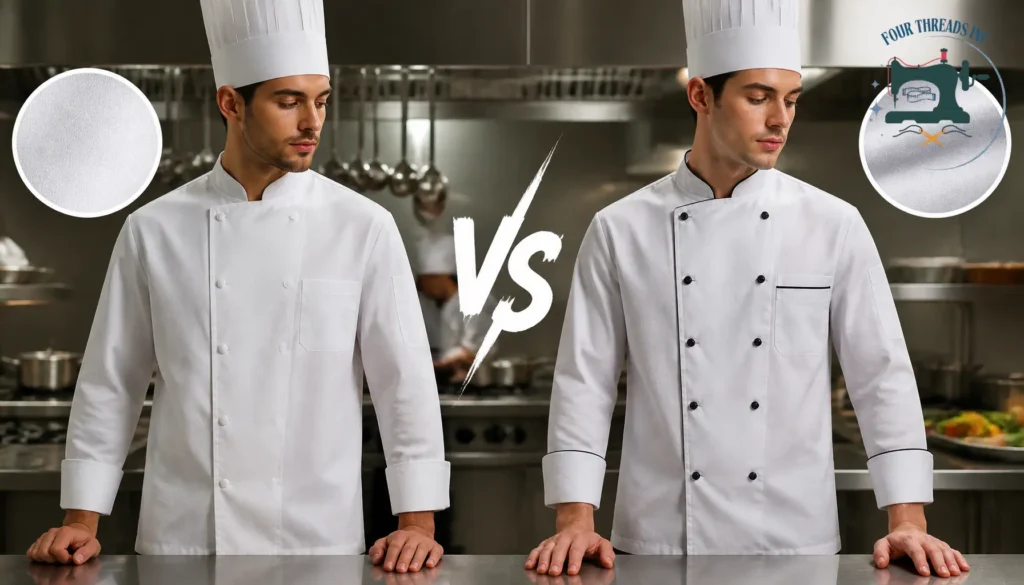
Tour a professional kitchen in India, and you are more likely to spot uniforms than menus at first glance. A chef’s shirt is much more than a piece of clothing. It serves as protection from heat and spills while allowing for twelve-hour shifts at the kitchen’s height.
The issue of whether 100% cotton or poly-cotton is the better choice is an old debate still active, with manufacturers of clothes for chefwear, as well as kitchen professionals, offering different views. This article is the only one that will tell you the truth in a clear, unbiased way to make your decision easier.
What Is a Cotton Chef Shirt?
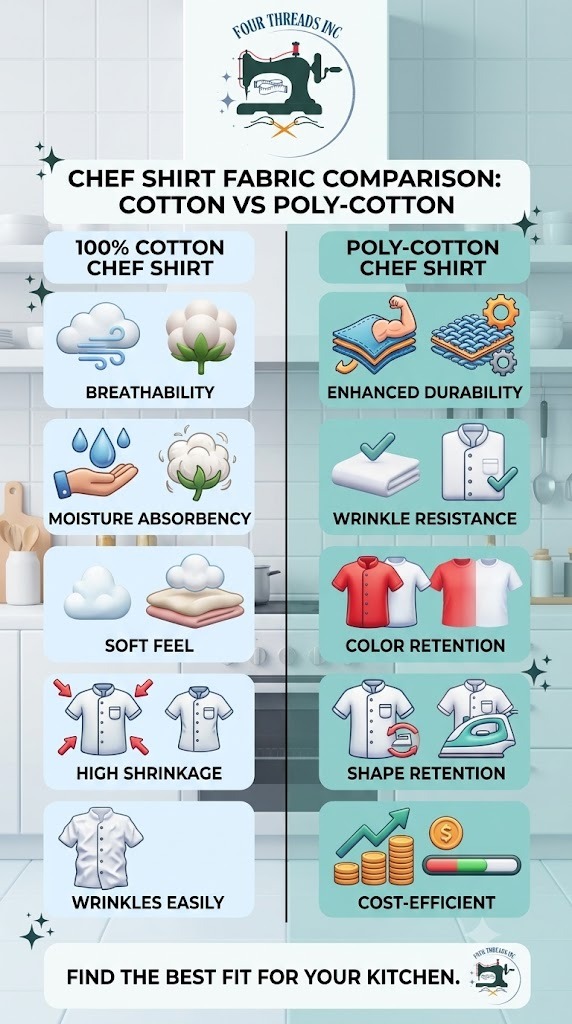
A cotton chef shirt that is exclusively woven with cotton fibers is a type of chef’s uniform. Cotton has remained the top pick for chef whites throughout the years because of its breathable character and sweat-wicking properties during the most sweaty and long shifts at kitchens.
- Natural Fibre Composition: 100% cotton chef shirts are 100% natural cotton, meaning the whole fabric is made of cotton threads coming from the cotton plant. So, it is easily recyclable and safe for human skin, which plays a huge role if you are wearing the garment most of your time, like 10-12 hours a day.
- Breathability and Airflow: Cotton fibers themselves give a structure that helps the circulation of the air through the fabric. In the case of an Indian-style hot kitchen, where temps usually go over 40 degrees Celsius at the stove area, the ability of cotton to breathe is what helps in keeping the body of the wearer much cooler compared to non-breathable garments.
- Moisture Absorbency: Since cotton is a natural fibrous material, it has the ability to uptake up to 27 times its weight in water, which basically means it gets the sweat away from the body. But the big downside is that it does not give back the moisture as quickly, so when you are wearing a cotton shirt for hours, you may notice it becoming heavy.
- Soft Hand-Feel: Because of the fibers coming from nature, a cotton shirt is a much softer textile that can be felt. Chefs, however, may have described the feeling in their words quite accurately – comfortable in one go without needing a break-in period as certain synthetic blends require.
- The Disadvantage: Despite that cotton is good enough for skin protection against heat, it is very sensitive to wrinkle formation, it gets easily shrunk through several washings, and the chef shirt made of cotton quickly ceases to look crisp.
What Is a Poly Cotton Chef Shirt?
This hybrid approach has become the preferred choice for restaurants and hotels across India.
- Blended Fibre Construction: Poly-cotton typically combines cotton and polyester in ratios such as 65/35, 60/40, or 50/50. The exact ratio determines how the final fabric behaves, with higher cotton content favouring comfort and higher polyester content favouring durability.
- Enhanced Durability: Polyester fibres add tensile strength to the fabric, making poly-cotton chef shirts resistant to wear and tear from repeated industrial laundering. A quality poly-cotton shirt can withstand over 100 commercial wash cycles without significant deterioration.
- Wrinkle Resistance: Unlike pure cotton, poly-cotton resists wrinkling during wear and after washing. This means chefs spend less time ironing and more time in the kitchen, maintaining a professional appearance throughout their shift.
- Colour Retention: Polyester holds dye more effectively than cotton, so poly-cotton chef shirts keep their colour vibrancy even after months of heavy washing. This is particularly important for coloured chef shirts that need to look presentable in front-of-house settings.
- Cost Efficiency: While the upfront cost of poly-cotton may be similar to cotton, the longer lifespan and reduced ironing time translate to lower cost per wear. For restaurants ordering uniforms in bulk, this represents significant savings over a year.
The poly cotton chef shirt addresses the practical limitations of pure cotton while retaining enough natural fibre content to remain comfortable. This balance is why industry experts consistently recommend it for professional kitchen environments.
Cotton vs Poly-Cotton Chef Shirts: A Direct Comparison
When choosing between cotton and poly-cotton chef shirts, the decision comes down to what you prioritise: maximum comfort or maximum durability. The table below provides a side-by-side comparison across key criteria.
| Criterion | 100% Cotton Chef Shirt | Poly-Cotton Chef Shirt |
| Breathability | Excellent | Good |
| Moisture Absorbency | High (holds moisture) | Moderate (wicks moisture) |
| Wrinkle Resistance | Low | High |
| Durability | Moderate | High |
| Colour Retention | Moderate | High |
| Shape Retention | Low | High |
| Shrinkage Risk | High | Low |
| Ironing Required | After every wash | Minimal |
| Cost Per Wear | Higher over time | Lower over time |
| Ideal For | Low-heat kitchens, short shifts | Professional kitchens, long shifts |
For most professional kitchens in India, poly-cotton emerges as the more practical choice. However, the answer is not absolute. It depends on your specific kitchen environment, budget, and chef preferences.
Which Is Better, Poly Cotton or Cotton?
The question of which fabric is better has no universal answer because it depends entirely on context. A broad generalisation from experienced chefs is that polyester blends look smarter and more businesslike. Pure cotton looks more casual and comfortable.
- For Professional Kitchens: Poly-cotton wins because it preserves a crisp, professional appearance through a full shift. The wrinkle-freeness and retention of shape ensure that your team makes a good impression throughout the entire time, even right from beginning to end in very busy service hours.
- High-Heat Workplaces: In situations where the environment in your kitchen is very hot, it might be better to opt for 100% cotton that, due to its higher breathability, makes the wearer feel more comfortable. Yet, this superiority is quickly undone when the cotton gets wet from the sweat which can occur at around peak 2 hours of service, according to conditions.
- Cheaper Kitchen Operation: Poly-cotton blend is more practical for operations that are cost-wise very strict. Just a lower rate of the requirement to iron saves hours each week of manual labor, and longer lasting life means that you have to buy shirts for your staff less times throughout the year.
- Upscale Hotels/Restaurants: A great number of fine-dining restaurants in India that want to look their best choose poly-cotton mainly for the reason that they give a much neater, more orderly look. For example, a white/black, well-fitting, poly-cotton chef shirt will give a more elegant and formal impression than the wrinkled alternative one can buy when working on cotton only.
- For Environmental Responsibility-Driven Branding: Since cotton is a biodegradable fibre that does not release micro plastics when being washed, it seems obvious so that for environment-conscious purposes, this fabric would be a better pick.
So, in most Indian commercial kitchen environments, a choice on the side of poly-cotton shirts will be the most practical one; but, your final decision still must be based on your business requirements on an individual basis.
Is 80% Cotton 20% Polyester of High Quality?
One of the most popular ratios is the 80/20 poly-cotton. Based on how well a blend suits the needs of the users, the level of quality will be determined because of this.
- What Does the Ratio Indicate: An 80-20 material consists of 80% cotton and 20% polyester. A higher proportion of cotton gives fabric a closer resemblance to pure cotton with feel and touch compared to a 50/50 blend.
- Degree of Comfort: As cotton makes up most of the content, such shirts keep the body cool and the touch is quite soft. So for the staff, mostly chefs, if they would rather wear natural fibres and yet have slightly higher durability, a garment with mostly cotton will be quite comfortable.
- Limitations with Torn-Proofness: Due to being only 20%, the polyester component adds some level of resistance to wrinkles, strength and also durability, but not quite as much as one could expect from a much higher proportion of synthetic fabric as in a 65/35 or 50/50 mixture. So, if your kitchen environment places the highest premium on both durability and minimizing ironing, going for fabrics with higher levels of polyester would be a better option.
- Ideal Scenarios and Situations: The material of this combination is suitable for serving crew members of FOH who desire to maintain their good image while at work but at the same time, also need physical comfort for long hours. Then again, they are also a type of material that one would recommend to chefs working in slightly cooler or normal temperature kitchens.
- Quality Aspects and Perception: Cotton content being relatively high will usually indicate that a product is of good quality, mainly due to the feel of the fibre. But, when a product is mainly intended for heavy wear and tear in a kitchen, the performance-related advantages of a balanced blend can even be superior to the quality feeling, which means one will rarely go wrong by choosing a fabric with a more equal share of the two fabrics.
It is not wrong to say that a chef shirt made of 80/20 poly-cotton fabric is a good quality clothes but it is still one of the fabrics which is more or less comfortable or durable per the requirements of the wearers. If you mainly look for a comfortable material then you will pick this blend but if your focus is durability, then go for a higher proportion of polyester.
What Are the Poly-Cotton Drawbacks or Disadvantages?
Even with the truth that the use of poly-cotton brings many advantages, it is also a fact that it has its fair share of shortcomings and limitations. Getting to know about them and being familiar with their existence are the factors that one should have before buying or choosing a particular type of fabric for the kitchen staff’s work shirt.
- Lowered Comfort Level: Due to the lessened ventilation through the polyester layer compared with the cotton fabric, the poly part reduces the level of breathability. So, this will lead to the feeling of the hot shirt being uncomfortable, in particular during extended shifts. It also makes the temperature in the kitchen feel quite suffocating to the workers wearing such a shirt.
- Lower Moisture Absorbency: Polyester cannot soak up water the way cotton does. It pushes moisture toward the surface so evaporation can happen, which sounds useful until you are standing in a humid kitchen and the fabric just sits there against your skin, damp and clammy.
- Potential Skin Sensitivity: A small number of people react to polyester fibres with irritation or static cling, mostly when the air is dry. It is rare, but if any of your chefs already struggle with sensitive skin, this isn’t something to brush off.
- Less Premium Hand-Feel: There is a slightly synthetic quality to how poly-cotton feels, and plenty of wearers notice the difference right away compared to pure cotton. On the bright side, that first stiffness often softens once the shirt goes through several wash cycles.
- Environmental Concerns: Polyester comes from petroleum and sheds microplastics every time it’s laundered. For an establishment that puts environmental sustainability front and center, pure cotton stands as the clearly better choice.
None of these downsides automatically rules out poly-cotton in a professional kitchen. But they deserve honest weight alongside the fabric’s real strengths in durability and how sharp it keeps looking.
Is It Better to Wear Cotton or Polyester Shirts?
Outside the kitchen, picking between cotton and polyester really depends on what you are doing and where you are. Chef shirts are different, though. The work itself puts very specific performance demands on the fabric.
- For Physical Work: Polyester’s moisture-wicking properties matter most when someone is moving hard and sweating steadily. Through a dinner rush, that means a poly-cotton chef shirt tends to stay drier and feel lighter than pure cotton, and that small difference adds up over six or eight hours.
- For Static Environments: If the body is at rest and there is not much sweat, cotton pulls ahead. Natural fibres simply breathe better and feel softer in situations like that.
- For Presentation: Wrinkle resistance is where polyester and poly-cotton shine. They hold a crisper look for far longer, and in a professional kitchen that crispness reflects directly on the establishment.
- For Allergy Considerations: Cotton does not cause skin reactions nearly as often because it is hypoallergenic. A chef with sensitive skin might well choose cotton, even knowing it will mean reaching for the iron more often.
- For Indian Climate: Most of India runs hot and humid, and in those conditions poly-cotton is the practical middle option. Compared to pure cotton it wicks sweat away more effectively in humidity, and the breathability remains acceptable, not great but workable.
For chef shirts specifically, the equation shifts because the kitchen itself sets the bar: heat, spills, constant movement, washing day after day. That combination usually pushes most users toward poly-cotton.
How Four Threads Inc Can Outfit Your Kitchen
Choosing the right chef shirt solves one problem. Finding a supplier you can actually count on for quality and consistency solves another, and sometimes that second one turns out to be harder.
- Premium Fabric Selection: Four Threads Inc stocks chef shirts in both premium cotton and durable poly-cotton blends, so the decision about fabric doesn’t get forced by limited options. You pick what your kitchen actually needs.
- Bulk Order Capability: Some operations run five people in a small restaurant kitchen, and others manage a fifty-person hotel brigade. Either way, Four Threads Inc fills orders of every size without the quality slipping between batches.
- Customisation Options: Customisation is also another key feature that Four Threads Inc offers. Embroidered logos, custom colours, and modified sizing are just amongst the many available ways through which each member of a given team can look alike and also very smartly dressed.
- India-Specific Design: The Indian kitchen is also something that Four Threads Inc has made sure that their chef shirts are appropriate for the climate of such an environment and the needs of its users. They have put much thought into it and have made sure that the shirts are breathable and durable at the same time, and the sizing is also as the Indian chefs’ preferences.
- Competitive Pricing: Cost effectiveness is another key thing that Four Threads Inc brings to the table, or rather, the value per wear concept that focuses on the cost of a garment after every time we wash and wear it. The chef uniform collection from Four Threads Inc is initially budget-friendly but at the same time, they are of such great quality that even a couple of years of intensive washing won’t make holes in them or even cause any sort of fading.
Quick Summary of Checklist For Fabric For Chef Shirts
This short checklist will help you make an informed decision while placing your order for uniforms:
- Consider the heat level of your kitchen: if temperatures are very high, we would recommend pure cotton; poly-cotton is suitable for your kitchen if it runs at a moderate temperature.
- Evaluate your laundry setup: Poly-cotton for industrial laundering, cotton for gentle home washing.
- Examine your style expectations: for the chefs whose role involves front-of-house visibility, poly-cotton is the best option and for back-of-house ones where style is much less important it is still okay to choose cotton.
- Take into account your finances: Poly-cotton is more economically beneficial over time whereas cotton is a better bet when it comes to lower investment in upfront costs.
- Factor in chef preference: Involve your team in the decision to ensure comfort and compliance.
Final Verdict: Cotton or Poly-Cotton?
To answer the long-standing question, ‘Which type of fabric should one choose for a chef shirt, cotton or poly-cotton?’, it boils down largely to what kind of factors you are prioritizing in that specific aspect. Whether it is the work environment in your kitchen that dictates the choice of fabric, or whether financial considerations are the main driver, or again comfort-related ones, like preference of one’s own style of wear – all of these should be put into the equation for reaching the final decision.
Overall, usually professional kitchen environments in India seem to be better served with poly-cotton as it is a compromise of the best points of the natural and synthetic threads such as toughness, appearance, and cost-efficiency. What makes Four Threads Inc stand out is that they have a good range of both materials and have the right mix of features at each price point, so that your chefs’ uniforms will be in keeping with the rest of the staff, your chefs will be able and willing to perform at their best, and it will all happen through a highly satisfactory level of service.
FAQs
A regular cotton shirt is not designed for kitchen environments. Chef shirts typically feature heat-resistant construction, stain-repellent finishes, and reinforced stitching that standard shirts lack. Using a regular shirt may compromise safety and durability.
How often your chef shirts should be replaced largely depends on the type of fabric and how you use the washing facilities, i.e. whether it is commercial or household laundry. In most cases, the lifespan of a poly-cotton chef shirt in a professional restaurant would be up to 18 months, although in most commercial situations, it is usually just over 12 months. With pure cotton chefs wearing pure cotton shirts, one can expect that their shirts can last, due to the natural properties of the fibers and the lesser resistance to washing, from 6 months up to a year before it is time for a replacement.
Without a doubt, yes, Poly-Cotton chef shirts are perfect for Indian summer. The lightness of the shirt is also taken care of. The moisture-wicking properties of the fabric allow the chef to remain comfortable even when sweating. The shirt is also wrinkle-free due to its fabric construction, making the Chef look professionally dressed even on a hot summer day.
For most professional kitchens in India, 180 to 220 GSM fabrics for a poly-cotton chef shirt will be appropriate. A GSM around 180 grams will ensure the shirts are not too hot on Indian chefs but, at the same time, provide sufficient durability to last at least a couple of years with normal washing. The same range works reasonably well for 100% cotton fabric. A fabric that is thinner (lighter GSM) will make cotton shirts cool and breathable, making them more comfortable in the Indian summers.
1 reply on “Cotton Chef Shirt vs Poly-Cotton: Which Fabric Is Better for Professional Kitchens?”